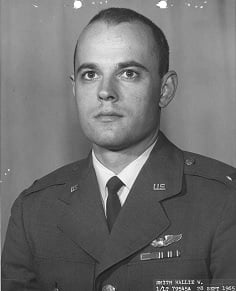
Capt. Hallie William Smith
United States Air Force

2Lt. Hallie
(Bud) Smith
Reese AFB TX 1965 class photo
provided by Jim
Selander


Bud at Reese Air
Force Base TX
photo provided by Jim Selander
![]()

Photo Courtesy of Doug Hutchinson
Back row: Maj.
Norm Goldberg, Maj. William Elswick, Maj. Dick Seidezahl, Capt. Ron Newton,
Capt. Dave Devenport, Maj. Doug Hutchinson and Capt. Fred Kittle.
Front row: Lt. Chris Leithiser,
Lt. Butch Hadzima, Lt. Ed Kincaid,
Lt. Bud Smith, Lt. Wendell Phillips, Lt. Dale Wiener,
Capt. James Stewart and Capt. Jim Selander. 1967. Mountain Home AFB Idaho
class photo.
![]()
Hallie (known to everyone as Bud) William Smith was born October 16, 1941 in Portland Oregon. Bud grew up in the Portland area and graduated from Milwaukie High School in 1959 and Lewis and Clark College in 1963. He got his commission at Officers Training School February 4, 1964, married Judy Smith February 8 and went on to pilot training. Bud graduated from Undergraduate Pilot Training on March 26, 1965 from Reese AFB, TX.
NEW Please check this new page link about Bud Smith from his childhood friend, Lloyd White. Here you will find some of Lloyd's memories up until he last spoke to Bud, many photos of Bud from Lloyd's Milwaukie High School Senior year book and two newspaper items. Thank you, Lloyd White, for your most valuable contribution to Bud's page and his memory. Also you will find a link to Bud's photos and information from his Lewis & Clark College days plus other people who have adopted Capt. Hallie (Bud) Smith.
From November 8, 1963 until his last assignment October 15, 1967 to the 16th Tactical Reconnaissance Squadron as an RF-4 pilot in Tan Son Nhut Air Base, Bud was stationed in Texas, Idaho and England.
Capt. Hallie Smith and 1st Lt. Charles Bifolchi departed the base at 12:55am January 8, 1968 on a night photographic mission. Scattered clouds at 2,000 to 3,000 feet prevailed in the area with a 2,000 foot overcast in mountainous areas. There was also extreme haze.
The flight was monitored by radar and at 1:30am was cleared into the reconnaissance area. At 1:35am a call was made to the crew that their flight could no longer be followed on radar and the call was acknowledged. There was no further radio or radar contact. When they failed to return to the base at 3:55am as expected the crew was reported missing and search and recovery forces were alerted.
At daybreak on January 8, 1968 an electronic and visual search was conducted with negative results. Later that day a crew member of a helicopter observed wreckage of an aircraft at the top of a 7,200 foot ridge located approximately 3 miles from their mission area. A pararescueman was lowered to the crash site. No bodies or parachutes were sighted, however a piece of wing tank was recovered which was later identified as the type used on an F/RF-4 aircraft.
On January 9, 1968 the long range reconnaissance patrol team (4th Infantry Division) was dispatched to the scene, but due to adverse weather conditions the team failed to reach it's destination until January 11, 1968. They observed parts of two external fuel tanks on top of the ridge, one which was ripped open and smashed from front to end, a broken center section of wing was found wedged in branches of trees with the jagged end section showing part of AF star markings. Pieces of copper tubing and electrical wiring were noted. Various small pieces of metal were on the ground and in tree tops. In the area of impact there appeared to be part of a hydraulic strut approximately 30 feet in length, small bits of plexiglass, foam rubber and honey combed metal. The team retrieved a small metal block from the impact sight with printed numbers and was identified as a valve assembly. It is an oxygen pressure valve listed for F/RF-4 aircraft only.
No bodies or parts thereof or parachutes or parachute cloth, no flying clothes or gear and no survival equipment were observed in or around the impact area, including the personal weapon of Capt. Smith. No further search activities were conducted due to heavy concentration of enemy forces in the vicinity of the wreckage. It is unknown whether Capt. Smith and 1st Lt. Bifolchi were able to eject before the RFC-4 crashed into the side of the mountain. There have been many pleas and promises for casualty resolution operations, but records don't indicate any such operations or success. On November 6, 1975 Hallie (Bud) William Smith was officially declared dead by our government.
Sources- Library of Congess reports on Capt. Hallie Smith obtained by Heath Love and a December 1969 Oregonian newspaper article obtained by Patti Woodard.

![]()
UPDATE
On 1st Lt. Charles Bifolchi Who Was With Bud When Their Aircraft Crashed
![]()
I have been privileged to make the acquaintance of Heath Love who also adopted Bud and had a new MIA bracelet made with Hallie Smith's name on it- thank you Heath- and Doug Hutchinson who was in the 16th TRS with Hallie (Bud) Smith. Doug told us about what he knew of Bud and their life at the time of Bud's disappearance. Following is his story and I am so grateful for Doug's contribution in making Bud Smith so real to us and his page more personal. Thank you Doug!
![]()
Hallie (Bud) Smith by Doug Hutchinson
I first met Bud Smith when a bunch of young RF4C pilots and some not-so-young Navigators gathered one summer day at Mountain Home AFB in Idaho. The pilots had all just come from either Ramstein Germany or Alconbury England where they had been unwilling "backseaters". Now they gathered to select the navigator of their choice to be their backseater in the 10th Tactical Reconnaissance Squadron training for a tour in Vietnam.
Bud was one of the pilots, I was a backseater. Bud selected Ron Newton as his backseater and I was chosen by another young pilot named Dale Wiener.
We all trained together there in the desert. I would have to look at our group picture (which I can share with you if you would like to see Bud) to tell you how many were in our group, but my rough guess is that we were about seven or eight 2-man crews.
On completion of our training, we all went to Nam on the same aircraft. We were assigned to the 16th Tactical Reconnaissance Squadron flying out of Tan Son Nhut airbase on the outskirts of Saigon. From the time that we arrived until about a month after Bud was lost, we lived in the north part of Saigon in an old French Villa. We had 2-man rooms, and Bud chose to bunk with Capt James Stuart another pilot in our group and a friend of his. We had been in Saigon only a short time when Stuart was hurt in a motorbike accident and was shipped out to a hospital in Japan and later on to the U.S.
I had found that flying every day and even twice a day could make the time go by faster. So I took all of the extra flights that I could get. In a number of cases, I was privileged to fly with Bud Smith.
Bud was a terrific pilot. He was precise and confident. It was a pleasure flying with him because his ability and demeanor made the flights comfortable. I say that because it was not always true when sitting in the backseat with some pilots, particularly "staff wienies." Since we flew the RF4C, and the majority of our missions were at night we were fired upon during some portion of every mission.
One warm night, around midnight, about a week after Christmas 1967, I grabbed the opportunity to fly a night mission with Bud Smith. It was a a simple mission up in the Highlands of South Vietnam north and east of Dak To. It was what we called an "area cover" where we flew at about 2000 feet altitude in the dark and flew overlapping "racetracks" covering an area with infrared film of the ground. The purpose was to expose the nighttime cooking fires of the VietCong on the ground.
This area cover was not easy because it logically had to be flown on a North-South axis, and just beyond the north boundry of the area the mountains leaped out of the earth. They were imposing. In the daylight they looked like the prows of ships rising out of the jungle. They were high, rugged, and ominous looking.
On our very first pass, it was obvious that as we cleared the north boundry of our area, Bud would have to go to the Terrain Avoidance radar mode, and pull up at a very sharp angle as we literally flew up the face of the mountain in front of us.
We had only done about one or two passes when right in the middle of the climb up the mountain face, the radar failed. The silence was palpable in the cockpit. I think that we both held our breath until we knew we were clear of the top of the mountain. Since we were out of business we returned to base mostly relieved and still surprised since the radar in the RF4 almost never failed.
About a week and a half later, I had the night shift Duty Desk there in the squadron operations building. About midnight I looked up to see Bud Smith and Chuck Bifolchi coming toward me for their "checkout" They were suited up to fly,wearing their g-suits and survival vests and carrying their helmets and checklists. Before flying each crew had to stop by the duty desk and give the desk officer a copy of a map of where they were flying that night/day, and have their emergency radios checked and respond to a checklist of items carried.
I laughed when Chuck gave me their map and I saw that he and Bud were going back to do the very same area cover that Bud and I had tried to fly the week or so before. Although Bud was basically a serious young man, he had a good sense of humor, and teased me by saying something about taking along a "good" backseater who wouldn't turn off the radar on him.
That was the mission where they were lost. In addition to having flown almost the identical mission with Bud previously, I also was the person who first realized that they were overdue and ended up having to start the search effort that morning.
In the event that you would like to be able to envision what went on that night, here is how I remember it and what a typical mission preparation was like:
The night that Bud came up missing, he and Chuck Bifolchi checked out at the squadron operations desk at around 2330 hours. As usual, they estimated flight time not to exceed 2 and one-half hours, since that was the normal fuel load for an RF4C. I don't remember their exact takeoff time, but I would guess that it was somewhere right around midnight.
Once you walked out of the squadron operations section you walked through a door that led into the maintenance hanger adjacent and out its main door over to the revetments where the planes sat. It would have been really dark there on the tarmac with minimal lighting so as not to attract attention to the area.
The normal procedure would have been for Bud to talk to the crew chief and do a walk-around while Bifolchi climbed up into the rear cockpit and started programming the Inertial Navigation System (INS) which usually took around 15 minutes. All of that time of course, the Wolverine external power cart would have been screaming in the darkness at an ear-piercing level.
About the time the INS came on line, Bud would have climbed the ladder to the front cockpit and would have begun his checklist. A short time later, the crewchief would have yanked the wheel chocks and the airplane would have moved out of the revetment area and onto the taxiway for its progress to the end of the runway. That time of night, there would have been little ground traffic so they would have moved along quite smartly up to takeoff position where they would complete the last of the ground checklist. In position, standing on the brakes, Bud would have put the throttle into afterburner and released the brakes and they would have been off the ground and into the pitch black night air very quickly.
All of that should have taken about half an hour I would guess.
That night was uneventful at the squadron operations desk for the most part. There were not a lot of troops flying that night, and the early hours of the morning were spent checking people back in as they returned from their early evening flights.
I remember that around 0200 hours I began to get a little "antsy" that Bud and Bifolchi had not yet come through the hanger door. As the next half hour progressed I became more concerned that they had not checked in, and fearing the worst, I began to review the checklist for a missing crew. At around 0300 hours, there was no question but that they were pushing the "overdue" envelope and I followed the desk checklist and notified the command center in 7th AF headquarters and alerted the squadron commander and operations officer.
Once that happened, things were out of our hands at the squadron level. 7th AF command post began a "search" of last radio and radar contacts and a check of all other airbases in South Vietnam where the crew might have diverted to in an emergency. At some point they made the determination that the airplane was "down".
Sometime just before daybreak 7th AF Headquarters launched a helicopter, I would guess a Jolly Green, to move to the area where Bud and Bifolchi had been targeted. Around 0700 we heard that the rescue bird had reported what looked like an impact area near the very top of one of the mountains just north of the target area. We also heard that they had put a PJ (parajumper) there on the ground to search but that he was rapidly extracted and they departed when the aircraft came under heavy gunfire. We also heard that the PJ had located a piece of an airplane while on the ground that indicated that it was from the aircraft flown by Bud and Bifolchi. None of those reports were ever verified to those of us who were Bud's flying companions. Once it was in the hands of the wienies at 7th AF it was as if it all became a non-event and no further information was ever shared to my knowledge.
Bud and I were not close friends but were more like "work companions", so I know little about him really except for that night when he came up missing. I do know that he was an excellent pilot and a really nice person.
Doug Hutchinson
Photos Courtesy of Doug Hutchinson

1967

RF4C in front of maintenance hanger at 16th TRC 1967.

Villa in town where Doug and others lived- Bud's building was in back. 1967.

10th TRS at Mountain Home AFB Idaho 1969. Doug is 2nd from left.

RF-
4C lithograph from Dale Messimer
![]()
See links to Heath Love's
Memorial pages on Bud Smith
here!
![]()
Please check out a
touching story by Cyn LoPinto
who had one of Bud's original 1970's POW/MIA
bracelets
A Moving
Experience
![]()
POW/MIA Graphic by Ron Fleischer.
![]()