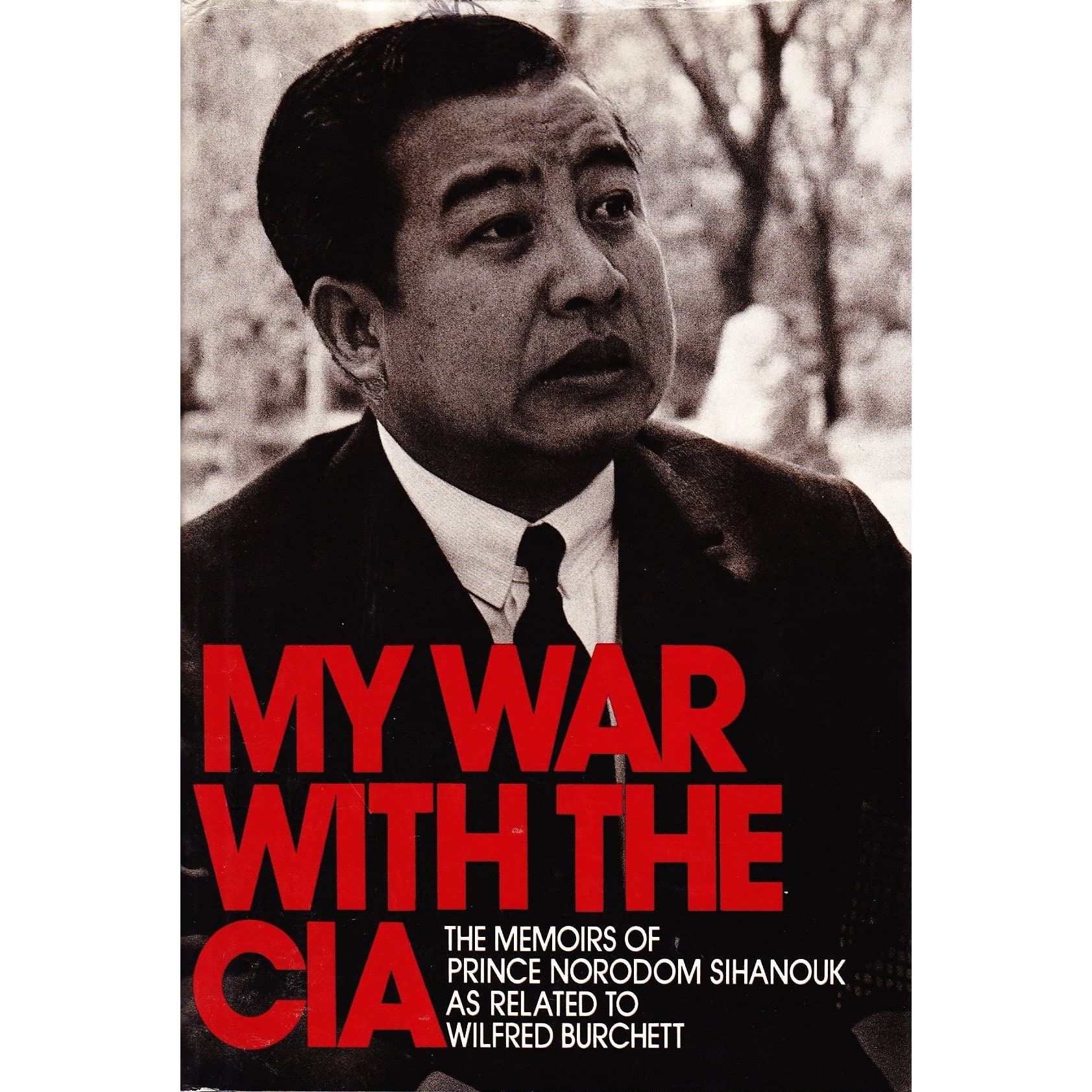
By Prince Norodom Sihanouk of
Cambodia
Along these lines and re my previous
posts on different subject matters re the Intelligence Community and abuses
thereof, the following excerpt from the book "MY WAR WITH
THE CIA," by then Prince, now King, Norodom Sihanouk of Cambodia, may be
of interest. It was written in 1983 but provides great insight to what is
happening today.
Bests,
John
Search Result 1
From: Neang,Savun
(kcra@sanetech.com)
Subject: From a Book " My War
With The CIA - Chapter 4 " By Norodom Sihanouk and Wilfred
Burchett
This is the only article in this thread
View:
Original Format
Newsgroups: soc.culture.cambodia
Date:
1999/09/11
Chapter Four
Resistance Starts
The
Proclamation which I drafted on the way from Moscow to Peking, and broadcast
over Pekin5 radio on 23 March 197o, had an immediate impact on my countrymen. I
formally demanded the dissolution of the Lon Nol regime as illegal 'and
unconstitutional, and called for the creation of a broad front of national
union, and a national liberation army:
A Government of National Union
will be formed. Pending Cambodia's return to a normal situation, a Consultative
Assembly will be established. Its members will be qualified representatives of
the Buddhist clergy, the army, the police, the provincial guards, youth,
intellectuals, peasants, workers and others who live by their labor,
industrialists, business people, civil servants, women, etc. belonging to all
patriotic, progressive and anti-imperialist tendencies.
A National
Liberation Army will be created to free the country from the dictatorship and
oppression of the clique of traitorous and pro-imperialist reactionaries headed
by Lon Nol, Sirik Matak and Cheng Heng and for the struggle against the U S
imperialists - their masters.
The Government of National Union, the
Consultative Assembly and the National Liberation Army will unite with the rest
of the people to form a united front to be known as the National United Front
of Cambodia which will have the double task of liberating the country and
reconstructing it after victory.
I knew from the experience of our
Vietnamese friends that the road to victory would be long and hard, but shorter
for us because of the experiences and successes of the Vietnamese. On 24 March,
I issued an appeal to my supporters inside
Page
60 from the BOOK My War With The CIA
the country to go
underground and await arms an training, and asked those abroad to try and make
their way to Peking. There were ferociously repressed uprisings and seizures of
power all over the country in the days that followed; the Western press
unfortunately reported only those in the eastern provinces close to the
capital, where journalists had easy access. In vast areas, Lon Nol's
administration simply evaporated before he could get it organized, and it has
not been reconstituted since. He tried to pass off the uprisings as the work of
the Vietcong, but Western journalists said otherwise. The Financial Times
accurately described them as 'an almost spontaneous outburst of rural dismay at
the departure of a ruler who made every effort to win the sympathy of the
countryside'.
Between 26 and 30 March, hundreds of my compatriots
unarmed - were shot down in cold blood for demonstrating in my favour. At least
thirty were killed on 27 March at the Neak Luong ferry, some forty miles from
Phnom Penh on Highway i, leading from Saigon. Another fifty were killed in the
town of Kompong Chain on the same day when Lon Nol's troops fired into a crowd
point-blank with anti-aircraft, heavy machine-guns. About fifty more were shot
down at Suong and Memot, both near the South Vietnamese border. journalists
reported counting about eighty corpses at Takeo and twenty to thirty each in
the towns of Prey Veng and Angtassom. The dead were indisputably Cambodians. I
have photos of long lines of our peasants, hands tied behind their backs,
awaiting their turn for the firing squad; of students executed by being beaten
to death in front of their fellow students. We were able to identify some of
the executioners, at least, as the C I A-suborned 'deserters' from the Khmer
Serei, whom Lon Nol had infiltrated into the Phnom Penh garrison and the
military police.
In a broadcast on 4 April, I reported that over three
hundred patriots had been massacred, and again advised my supporters to go
underground, 'to go into the jungle and join the resistance forces already
there', and where by now arms were available.
One of the developments
which pleased me most was
Page 61 from the BOOK
My War With The CIA
had already instituted a
witch-hunt against the left, and many young people had followed the example of
the three deputies and fled Phnom Penh for the security of the jungle. The C IA
was not slow to take advantage of the situation. They started a campaign of
rumours and distributed false tracts in the name of the Khmers Rouges - tracts
which I denounced at the time as lies. The armchair experts who accuse me of
having turned to the right in 1967, should take into account the extremely
tense and complex situation. For the first time, there seemed to be substantial
evidence that our independence was being threatened from the left, a
possibility I had always resisted admitting.
As for the long arm of the
C IA, there was a fascinating revelation by a C I A 'Green Beret', Captain John
J. McCarthy, Jr, one of the accused in the case of the murder of Inchin Hai
Lam, an alleged 'double agent' of Cambodian origin in the pay of the C IA.
McCarthy resigned his commission in May I971, disgusted at what he had had to
do - not to mention the way in which he had been treated by the US army for
having obeyed C IA orders. He revealed at the time that he had headed a C IA
team in an 'Operation Cherry', which involved leading a Khmer Serei unit deep
into Cambodia. This much was revealed in the Norfolk Virginia Pilot on 25 May
1971 - Further information about the McCarthy case was unearthed by Richard A.
Fineberg, whose report was published by Dispatch News Service
International:
John J. McCarthy, Jr, formerly a Captain with the U S
Army's Fifth Special Forces and commanding officer of a top-secret Cambodian
operation known as 'Operation Cherry', says Son Ngoc Thanh was a key figure in
his i 968 court-martial. McCarthy was accused of killing a Cambodian
interpreter, who was also a member of the Khmer Serei, a secret, right-wing
rebel sect, headed by Thanh and reportedly financed by the C I A.
The
ex-Special Forces Officer was convicted of murder and served two years of a
2o-year sentence before his conviction was overturned on appeal in 1970.
McCarthy says that his attorneys requested Thanh's appearance
Page 64 from the BOOK My War With The
CIA
At the two-day trial at Long Binh,South Vietnam, in
January, 1968, but the Army said it could not compel foreign nationals to
testify. At that time Thanh was living in Vietnam, where he was a powerful
figure among the Cambodian minority of that country.
Thanh did not
testify, but the trial record reveals that U S military officers met with
members of the Khmer Serei - and possibly with Thanh himself - at a pagoda in
Saigon shortly after the agent's death. At that meeting, the US paid an
indemnity, reportedly 25,ooo dollars, to the Khmer Serei for the death of their
member.
The transcript also indicates that Project Cherry was set up to
conduct incursions into Cambodia from across the South Vietnam border. For this
covert mission, the US hired Cambodian guides and interpreters, at least some
of whom were members of the Khmer Serei. During the trial, McCarthy identified
the Khmer Serei as an 'organization which in effect plans the political
overthrow of the Cambodian government'.
Although the heavily-censored
unclassified version of the transcript makes no direct reference to Thanh, the
record refers to a man named Tan Son Hai, who was identified by one member of
the Cherry team as 'the leader or high priest of the Khmer Screi'. McCarthy
told this reporter he believes that Thanh and Ton San Hai are 'one and the same
person'.
Prior to the trial, the Khmer Serei presented McCarthy with a
gold medallion for his 'revolutionary act' on the assumption that he had killed
the agent, whom the Khmer Serei believed to be a Communist-trained double
agent. The citation accompanying the award was signed by (Son Ngoc) Thanh as
'leader of the Khmer Serei'.
Excerpts from the unclassified part of the
transcript which have come into my hands are most revealing. For instance, the
testimony of Sgt Ben W. Hancock, a member of MeCarthy's team, testifies under
oath regarding a meeting he arranged between 'Tan Son Hai' and a Special Forces
officer following the killing of the agent. This verbatim account is from page
138 of the trial proceedings:
Hancock: Because Special Forces was
involved in the ... (classified) he asked me if I would go to the pagoda to see
if I could make an arrangement for him to meet with Tan Son Hai. Q: Who is Tan
Son Hai? A He is the leader of the ... (classified) in South Vietnam.
Page 65 from the BOOK My War With The
CIA
Q: Did anything occur with reference to this proposed
meeting?
A: I made a meeting for 6.oo that evening. And Col. Grover,
myself and Maj. Adams met with Tan Son Hai, and the interpreter. And Col.
Grover told them exactly what happened; they thought he had been killed by an
American captain.
Q: What, if anything, was their reaction?
A:
Well, he didn't seem bitter or anything, so first he asked how much money the
American government would pay for Inchin Hai Lam's death. So a price was agreed
on; we made an arrangement, or he made an arrangment with me to deliver the
body the following morning to the pagoda in Saigon.
On page 141 of the
same verbatim record, Hancock further identifies 'Tan Son Hai' as 'the high
priest or leader of the Khmer Serei' so there can be little doubt that it was
the arch-traitor, Son Ngoc Thanh, which explains why the US army was so
accommodating in protecting him from appearing at the court-martial. McCarthy
subsequently informed journalist Fineberg that the compensation paid was 25,000
dollars. The Fineberg report continues:
Although Project Cherry ended
prior to McCarthy's trial, Green Berets continued to conduct covert
intelligence operations in Cambodia for the C IA.
The 1969 death of
another suspected double -agent emploved on a secret Cambodian intelligence
project caused a sensation in the press when the Army attempted to
court-martial eight Green Berets, including Col. Robert Rheault, the commanding
officer of the Fifth Special Forces in Vietnam. The Army dropped the charges
when the C I A refused to testify.
Captain Robert F. Marasco, one of
the Green Berets involved in the latter case, ran two intelligence nets in
Cambodia during 1968 and 1969. His mission, he told this reporter, ranged from
'pinpointing targets' and gathering information in Cambodia, to 'keeping tabs'
on the whereabouts of Sihanouk when the Cambodian ruler visited the
countryside. Marasco said he hired and trained Khmer Serei agents, as well as
other Cambodians for his missions.
On 2 June 1970, Marasco revealed in
an interview with the National Broadcasting Company that the code name of his
Page 66 from the BOOK My War With The
CIA
mission was ' Blackbeard ', that it was divided into
two groups with a network of agents 'in all of the Parrot's Beak and sometimes
as far as Phnom Penh'. Among the tasks of the twenty South Vietnamese and
Cambodian agents employed by Marasco was that of keeping watch on Prince
Norodom Sihanouk,l which meant, among other things, deciding on propitious
moments for assassination attempts.
What 'Operation Cherry' and the 'B
57' groups were really up to may never be known. journalists have informed me
that it is unprecedented that the full transcripts of the McCarthy trial were
put on the 'top secret' list. Not the least of C IA activities in 1967, at the
time of the Samlaut affair, was the distribution of inflammatory leaflets in
the name of the Khmers Rouges aimed at giving Lon Nol the pretext he needed to
step up his persecution of the left and to drive a wedge between the Khmers
Rouges and myself. . Fortunately the jeep accident in which Lon Nol was inlured
removed him from the scene at a critical moment, and I was able to look into
the Samlaut affair myself as soon as I returned. I found the peasants did
indeed have justifiable grievances, and I immediately dismissed the governor of
Battambang. I publicly announced the responsibility of the authorities in the
unhappy affair, rebuilt villages that had been destroyed by Lon Nol's troops
and settled the peasants back on their lands. Lon Nol's accident made it easy
for me to reshuffle the cabinet to bring back Penn Nouth as Prime Minister. In
an article written intrudes Cambodgiennes it was made clear that the rebellion
was a strictly internal affair without any foreign support or encouragement,
and the Royal Government will settle the problem by its own means and as it
thinks best. However, hostile propaganda and C IA agents carried out a frenzied
campaign of false information aimed at splitting the nation in two
irreconcilable and hostile parts in order to prepare a pretext for direct
interventions
1. The Fineberg account was published by Dispatch News
Service International, Washington, 5 April 1972. Marasco's NBC interview was
published in Interhational Herald Tribune, Paris, 3 June 1970.
2.
Etudes Cambodgiennes, official organ of the Royal Cambodian Government, No. 10
, April-June 1967
Page 67 from the BOOK My
War With The CIA
I did not know anything about 'Operation
Cherry' at that time, but I clearly recognized the long arm of the C I A in the
forged leaflets and in the phrasing of certain slogans that were launched
against me.
Sensational stories began to appear in the Western press,
picturing the oppressed Battambang peasants as being in bloody rebellion
against Sihanouk and demonstrating the hand of Peking and Hanoi in this
uprising. Worth noting is the opinion of a French journalist, G6rard Briss6,
who lived for many years in Cambodia, and who investigated the Samlaut affair:
Contrary to what was written at the time, it was not directed against
Norodom Sihanouk ... but against certain local petty despots ... The popularity
of Norodom Sihanouk among the peasant masses remained intact, as was proven by
the extent of the resistance organized over virtually the entire Cambodian
countryside.1 (Briss6 was referring to the resistance after the I970
coup.)
However, Lon Nol's witch-hunt against leftist intellectuals, and
the military campaign against the Battambang peasants, combined to drive both
groups into an attitude of open, armed defiance which died down after I
intervened in the Samlaut affair, then blossomed forth after the 18 March I97O
coup.
In connection with the cloud which passed over my relations with
Peking (but never with Chou En Lai, with whom I remained on the best of terms)
there occurred a regrettable incident in August 1967. The Chinese-Cambodian
Friendship Association in Peking had addressed a message to the
Chinese-Cambodian Friendship in Phnom Penh, implicitly advocating my overthrow.
This obviously amounted to direct intervention in Cambodian affairs and I had
no choice but to dissolve the Phnom Penh association, together with all such
bodies, and to replace them with official organizations. My critics jumped on
this as conclusive evidence that I had turned to the right. But when I went to
China in I970, Premier Chou En Lai told me that 1, in fact, had acted correctly
in thus assuring Cambodia's integrity, for all this had taken place at a time
when extremist elements had
1. From L'Anyde Politique et Economique,
Paris, July 1970.
Page 68 from the BOOK My
War With The CIA
gained control of China's foreign policy,
and were issuing all sorts of provocative instructions through their embassies
abroad. Not only Cambodia suffered from this, but in our case it did,
unfortunately, happen at a particularly crucial moment in our postwar history.
Chou En Lai told me that the leaders of the association in Peking had been
punished. In general, the 'ultras' who emerged at the height of the Cultural
Revolution were later thoroughly discredited, but not before much harm had been
done to China's relations abroad.
To throw my own dissenters -
rightists such as Lon Nol off the track, I occasionally made speeches attacking
the Vietminh, Vietcong and Khmers Rouges. The first two realized that the main
thing was my unswerving political, diplomatic and material support of their
resistance struggle. But I did not know at the time that the Khmers Rouges had
also understood this. The proof was their immediate acceptance of the alliance
for resistance in 1970.
What had depressed me in i967, when I saw so
many hundreds of Cambodian young people deserting home, studies and professions
to march off to jungle and mountain guerrilla bases, turned out to be a
blessing when I sounded the call for armed defiance in March 1970. The bases
were there; the arms came soon after. The NLF, which had been very reluctant to
give arms to the Khmers Rouges in 1967, thus risking a Cambodian civil war
which might bring about US intervention, had no such misgivings in March of
1970. Immediately after the coup they started distributing weapons stocked in
the frontier regions. When the Americans attacked six weeks later they were
dismayed to find the storage areas almost empty. A high proportion of these
arms went directly into the hands of the first units of our Peoples Liberation
Armed Forces.
The very rapid development of our armed resistance
something which astonished even our Vietnamese friends was due to the fact that
we had veteran cadres which had learned irregular warfare in protecting their
own lives and their bases from Lon Nol's raiding expeditions. There were bases
in Ratanakiri Province in the north-east, in the Elephant Mountains in the
south, and in the Cardamome
Page 69 from the BOOK
My war with the CIA
Mountains in the west. The
Khmers Rouges were quickly joined by tens of thousands of what some journalists
called 'Sihanoukists'. These were peasants and townspeople, soldiers, including
entire army units which had remained loyal to me, and Vietnamese and Chinese
residents who joined us for ideological reasons, or because they Saw no
alternative if they wanted to remain alive - and free.
By mid April,
most of Cambodia was liberated, and our forces were knocking at the gates of
Phnom Penh, eager to join our supporters inside the city. This, despite the
importation of the 'Mike Force' (K K K commandos) for the defence of the
capital. The Lon Nol-Sirik Matak r6gime was sagging at the knees, knocked on to
the ropes, and awaiting the final count, when the United States invaded
Cambodia with its own and Saigon forces on 3o April 1970, in one of the most
flagrant acts of unprovoked aggression in modern history. No word but
'-aggression' can be applied to this act. Lon Nol, to cover up his own
involvement, claimed that he had neither invited the Americans in, nor had
received any warning of the invasion. It is hard to believe, but this is the
official, on-the-record position of the Lon Nol-Sirik Matak government. On 2
May, in the first days of the invasion, Lon Nol was reported by Western
journalists as 'pondering' whether or not to lodge an official 'protest'. In
the end he decided to 'approve' the invasion!
The best he could do to
justify himself was to address a gathering of Buddhists on i i May, by which
time scores of towns and villages had been reduced to rubble and ashes by u S
air power, and hundreds of innocent civilians had been bombed, burned and
machine-gunned to death by American and Saigon troops. With this inept and
hypocritical dis quisition, he tried to vindicate the slaughter of thousands of
Vietnamese civilians in an officially decreed rampage of racism and terror
without precedent in our country's history That he should seek to justify
butchery and treason in the' name of Buddhism, the most humane and tolerant of
religious philosophies, provides a measure of the man's degeneracy. In a
broadcast over Radio Phnom Penh, he said
Page 70
from the BOOK My War With The CIA
I address this
appeal to my fellow countrymen who are Buddhist -It is believed that our
religion will last 5,ooo years. We at 2,500 years, right, in the middle, of the
Buddhist era. It is also believed that the Buddhist religion will prosper
during the next 500 years. According to an oracle, the current war in Cambodia
is a religious war. Our religion is Buddhism. We have our bonzes, our prayers,
our disciplines, and belief that good will be rewarded and evil will be
punished. The communists do not believe in religion because they do not believe
in the existence of Buddha.
I wish to inform my fellow countrymen who
are Buddhists that an oracle has predicted everybody will enjoy equal rights.
Everybody will be happy and good when this religious war ends. But while the
war is still going on, you must respect your religion and pray. Those who
follow this advice will be spared all misfortune and will be rewarded with
security and prosperity. The oracle who predicted a religious war in the middle
of this era said that gold ' silver palaces and will be erected in the middle
of the four branches of the Mekong, and that there will be killing in the
middle of the four branches of the Mekong. This means the enemy of Buddha will
kill the religious people. Then the King will flee, and a comet will appear.
When the Khmer people refused to abandon their Buddhist morality and to
aid the Vietcong aggressors, the war broke out in accordance with plans mapped
out by the Chinese and North Vietnamese communists. China does not love
Sihanouk; it is using him as a tool to help the Vietcong wage war in our
country with a view to transforming it into a communist base in South-East
Asia. To make it easy to understand, according to the Buddhist religion, there
must be war - a war against the Vietnamese communists who consider religion
their enemy. In this religious war against the Vietnamese communists, who are
the enemies of Buddha, there are many Buddhists who will come and help us. Our
country will win final victory on the battlefield as predicted by the oracle.
Therefore, we Buddhist believers must rise up together to struggle against the
enemy who is committing the war of aggression in our country.(1) One could
possibly deduce from the last sentence that Lon Nol was appealing to his
Buddhist compatriots to rise up against the Americans, but his intentions were
anything but that. I have italicized the repeated use of the expression
'religious war' in Lon Nol's ravings. This, together with the
i.Cambodia: The Widening War In Indo-China, pp. 109-12, Washington
Square Press, New York, February 1971.
Page 71
from the BOOK My War With The CIA
reference to the
'four branches of the Mekong', seems to be an attempt to explain the massacre
of over a thousand Vietnamese civilians, men, women and children, whose bodies,
arms tied behind their backs, were found drifting down the Mekong in mid April.
This terrible stain on Cambodian honour was well reported in the world press at
the time, but a 15 April dispatch from Jeff Williams of the Associated Press is
especially worth recalling. Writing from the Neak Luong ferry, Williams
described hundreds of executed Vietnamese bodies in the Mekong River. A police
observer at one ferry crossing counted over four hundred bodies in a single
morning, with others still floating down the river as far as the eye could see.
(1)
A religious killing! Many of the Vietnamese were also Buddhists.
And those who were Catholics? Buddhism preaches religious tolerance. Who are
'the many Buddhists who will come and help us'? Since when have Americans been
considered Buddhists? I would urge all members of the US Congress and the
American public at large to read Lon Nol's speech and then to assess the sort
of leaders to whom they have entrusted so many hundreds of millions of dollars,
and the political and moral philosophy being endorsed with American treasure
and military might - not to mention prestige. Americans might also meditate on
the following passages from the conservative Far Eastern Economic Review (2)
Foreign officials in Phnom Penh who brood over Cambodia's problem and
vie for Lon Nol's car may be a bit disconcerted to learn that the premier gets
some of his most intimate advice from a clique of Buddhist monks who often see
him for hours at a stretch.
High among these well-placed advisers is
Mam Prom Moni, a crafty-looking 20-year-old bonze whose confident air and
haughty demeanor befit his title: 'Grand Intellectual of Glorious Purity'. He
belongs to the Mohanikay sect. He describes himself as an astrologer,
mineralogist and historian! He sees Lon Nol each week but will not divulge the
content of their discussions beyond saying
1. The Publisher was not
able to obtain permission for Prince Sihanouk's use of this dispatch and has
inserted - this editorial paraphrase.
2. Published in Hong Kong, 16
January 1971
Page 72 from the BOOK My War
With The CIA
that they range from personal problems to
affairs of state. To provide some sense of the wisdom he shares with the
Cambodian leader, Mam Prom Moni offers the following predictions:
'Peace will come to Cambodia this spring, but will not endure until several
requirements are met: all Vietnamese, from north and south, must leave the
country ... U S businessmen must help Cambodia recover through heavy investment
- and they must act before their Japanese counterparts do!'
Perhaps
rumours of CIA-manipulated soothsayers are not so far-fetched after all!
One can readily understand why so many of my compatriots, faced with a
choice of listening either to the obscurantist ravings of this turncoat or to
logical, intelligent appeals to patriotism, national unity, and militant
solidarity with comrades-in-arms across our borders in Vietnam and Laos, did
not hesitate to choose the latter. With the invasion Of 30 April, Nixon's
military strategists hoped to crush our resistance forces before they could get
organized, and to smash the N L F in a vice between Lon Nol's forces and their
own. The western jaw of the vice did not close because Lon Nol's forces had no
stomach for the fight. Our embryo resistance forces, on the other hand, gave a
good account of themselves. The 'Vietcong Pentagon' proved non-existent; the
overwhelming bulk of supplies in the frontier bases have been transported
elsewhere - as the Americans were to find out in the spring Of I 972 - or are
in our hands; the 'sanctuaries' now spread westwards to include most of
Cambodia. Nixon's Cambodian adventure resulted in the destruction of many
Cambodian towns and villages, the loss of thousands of Cambodian - almost
exclusively civilian - lives. But from a military viewpoint it was a disaster
for the United States and its puppets - a disaster the extent of which Nixon
has never dared reveal to the American people.
The invasion of
April-May 1970 was the first baptism of fire for our PNLAFC (People's National
Liberation Armed Forces of Cambodia). Within a very short time, Khieu Samphan
and his comrades set up three types of forces; local guerrillas and regional
guerrillas and a regular army. If, in the
Page 73
from the BOOK My War With The CIA
beginning, these
branches lacked equipment, they more than made up for it by their superb
morale. How could it be other-wise when they had seen their homes looted and
burned; their parents massacred; their mothers, wives, sisters and daughters
raped? If there were Cambodians who still had no clear idea of the difference
between a Lon Nol and a Sihanouk after the coup of 18 March 1970, there were
none after the aggression committed - by invitation or not - on 30 April. The
seeds of our defiance fell on soil fertilized by the blood of our people.
Sihanouk propaganda? One need only follow the tragic course of events since 18
March 1970.
Page 74 from the BOOK My War
With The CIA
End Of Chapter 4
BACK