Aaron's AN/USM-118 (Hickok "Cardmatic" 1234) Page


General Description

The AN/USM-118 "Cardmatic" tests receiving and low power transmitting tubes. Tubes are programmed for test via plastic punched code cards. Unlike the 123A/B/R, dual section tubes (with identical sections) are tested with one card, tubes with dissimilar sections still require multiple cards. Most tubes are tested for transconductance. Heater to cathode leakage is indicated directly on the meter, other inter-element shorts via neon lamps. Quality (Gm or Ib) is indicated directly on the linear scale meter, however conversion to micromohs (or milliamps) requires the Test Characteristics manual to determine what meter range has been programmed from the tube test card. The internal bridge and measurement circuits give Gm readings within a tolerance of 3% (although a slight correction is necessary for high plate current tests). The linear scale meter is hermetically sealed and very accurate after calibration. There are multiple safeguards and protections against overload, later models have an auxiliary circuit that monitors for excessive meter current (the two transistors are in this circuit).

I consider this unit the apex of the Hickok line.


AN/USM-118A vs AN/USM-118B

The major difference is a two-transistor meter protection circuit in the 'B'. All of the units I've ever seen (with the exception of one) have been B's.

It is virtually impossible to tell them apart by looking at the identification plate or stenciled identification. The tester proper is usually labeled "TS-1479/USM118A" no matter what it is. Look for "part of AN/USM-118B test set" on the ID plate. In fact, all of the parts (cards, cells, tester, etc) are labeled something-NNNN/USM118A.

So, is it Junk or Treasure?

If it really is an old "A", it's junk.  Selenium rectifiers, soldered in caps, less meter protection and other bad ju-ju you don't want to mess with.  And it will be O-L-D.

There is an easy acid test to see if a unit is new or old.  Pull the black tube cover off by loosening the thumbscrews on either end.  Locate the 5U4 tube, it is the large one on the extreme right.  There must be two pots, one to the upper right and one to the lower right of the 5U4 socket on the tube sub-chassis.  They will be labeled something like "Q1 base adjust" and "Q2 base adjust".  If it has them, it's newer.  If they are missing, it's an old "A" clunker, pass it by.

Specifications

Dimensions: 19.5" x 9.5" x 16.5", 50 lbs (just the tester!)
Power requirements: 105-125 VAC, 50 to 400 Hz, 250 Watts
Tube line-up: 6AU8, 6CL6, 0A2WA, 6AW8A, 6CD6, 6C4WA, 6203 and 5U4GB (and two transistors in the meter protection circuit)


Why?

Why would anyone want such a big, heavy tube tester?

Unless you are testing gobs of tubes, you probably don't. The unit is a hernia waiting to happen. It's easily 10x the internal complexity of any other tester (8 tubes, 50 lbs, 250 watts), and has that many more things to go wrong.

But if you do test several tubes a day, or have several thousand you need to test, the USM-118 is the cat's meow because the settings are contained on pre-programmed punch cards instead of a dozen switches and knobs. The speed at which you can test tubes is primarily limited by how long it take the tube to heat up to it's operating temperature.

The unit is also very rugged, and has protection circuits layered on top of other protection circuits. The sensitive meter calibration is guarded by a two transistor fail-safe shutdown circuit.


How much are the worth today?

The military unit is more valuable than the civilian, being ruggedized, having a hermetically sealed meter, etc. But of course the military ones tend to have gotten beaten up more, too.  In any case, the main determinant of price is the card deck.   The second most important factor, and unfortunately the one least disclosed in units for sale is age. How old is too old?  Certainly avoid anything older than '68.  If given a choice, get absolutely the newest units you can, cause it's almost exactly like mileage in a car.  The newer units have exponentially less wear (and damage/corrosions/dents, etc) that the older ones.  They were made into the early '80s so there is quite a range available.  There are two ways to check the age, the most straightforward is to disassemble the unit and look at the date codes (the caps and the transformer, typically).  I can also translate the contract number into a date, but that isn't as easy.

Padgett Peterson has a set of pages about Hickok tube testers including the cardmatics. He has a nice chart of production dates and estimated prices of units where he pegs the cardmatics to between $500 and $800.

Tucker has some USM-118's occasionally, they were getting $700 when last they had any. For comparison, they sell the Hickok 539C, another popular tester, for $550.

Thomas J. Bruckner has the USM-118 priced for $750 and the required card deck for $500. 

I regret that my luck in finding serviceable units has been less than stellar. If you average in the junkers and/or broken units, incomplete or missing card decks (or cards decks missing testers!), I guess I've paid about $300 for each working unit and complete deck that I have. 

The best prices are probably at hamfests and swap meets, where you might find a serviceable unit on the cheap. Keep your eyes open!


Operating Instructions (from the sticker on the lid)

Place tube in socket and insert card.

  1. Observer short test lamps. Glowing lamps indicate shorted elements. Read meter scale 1, heater/cathode leakage. Warning note! Stop test if tube is defective.
  2. Push button 2 and read meter scale 2.
  3. Push button 3 and read meter scale 3.
  4. When neon light next to button 4 is lit, test the second identical tube section by holding button 4 down and repeating above tests 1, 2, & 3.


Test sockets

On replaceable, plug-in daughter board...
9 pin Noval
8 pin Loctal
8 pin Octal
7 pin Mini
7 pin
6 pin
5 pin
4 pin
Directly mounted on chassis...
9 pin Jumbo
On small plate on chassis...
8 pin sub-mini
7 pin sub-mini inline


Test circuit configurations

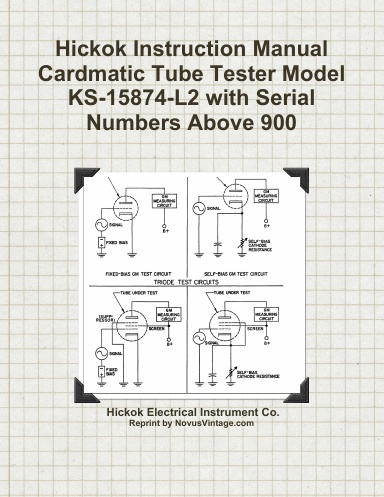
The strategy of the USM-118 is to test the tube under it's normal circuit operating conditions. In addition to operating voltage and plate current, here are the test circuit configurations that can be programmed. No, I don't know what "perveance" is, unless you are talking about Michael Jackson.

Triode Fixed-Bias Gm
Triode Self-Bias Gm
Pentode Fixed-Bias Gm
Pentode Self-Bias Gm
Heptode Gm
"Knee" test
Computer Tube On
Computer Tube Off
Full Wave Rectifier
Half Wave Rectifier
High Voltage Rectifier
High Voltage Diode
High Perveance Diode
Low Perveance Diode
0A2
0A3
0A2, 0B2 Leakage
Shorts and Cathode-to-Filament Leakage


Resources

This gentleman performs repairs and calibrations on Hickok testers, his prices are very affordable, and he is a pleasure to deal with. He can also fabricate new zener calibration cells for your unit, has new replacement hand punches, sells copied cards, etc...

Mr. Wendell E. Hall
3 Mockingbird Cir
Jeffersonville, IN 47130
Phone: (812) 282-9709

Kara Chaffe at tubewizard.com fixes Hickoks including the cardmatic, but I haven't had any personal experience with her repair service.

Leeds Electronics had some card decks ($550), reader assemblies ($125) and other parts.


Here are a couple sources for manuals (and maybe cards, testers, etc...)

A. G. Tannenbaum
PO Box 386
Ambler PA 19002
Phone: (215) 540-8055
Fax: (215) 540-8327
(Note the the manual Mike has is an older revision).

SND Tube Sales
5389 Ville Rosa Lane
Hazelwood, MO 63042
Phone: 314-770-0119
Fax: 314-770-9448


Standard Kit Contents

Navships 93883 Service/Operation Manual or Navelex 0969-LP-124-6010 Technical Manual
Navships 0967-113-6050, Technical Manual - Tube Test Conditions
50 blank test cards and 1 special hand punch
1 calibration cell and 1 set of 56 calibration test cards
1 set MK-827 tube test cards (2484 cards spanning 1556 tubes)
1 non-test card
1 plastic bookmark flag
1 SA-3 and 1 SA-4 adapter are included with the large card deck


Calibration

There is a routine and complete calibration procedure. Both use a calibration cell and special card deck. The complete procedure also requires a variac  and an VTVM (or DVM). 

Note that you need a 3047-4 or 3047-5 zener cell (and corresponding "new" card deck with the 1B, 1C & 1D cards) to perform the calibration procedure, the mecury calibration cell (3047-1 thru 3046-3) is useless even with the correct cards.  If you have a mercury cell, dispose of it properly.

You need to be very careful tightening the compression locknuts on the calibration controls (note the locking nut has a top and bottom, the bottom is the side with the threads cut thru)  because you can very easily end up over-tightening it and twisting the whole pot (and damaging the leads).  There is a little locking tab that is supposed to hold the pot in place, but it's easy to twist it right off.  This is especially true on the small pots as the little tab is aluminum, not steel.  The only way to fix this is to disassemble the unit and hold the pots stationary while tightening down the chassis nut.  This is particularly inconvenient on the two leakage pots, as they are behind two caps and hard to get a hold of.  Be especially careful with the locknuts on these two.  DO NOT OVER TIGHTEN THE LOCK NUTS!

Hints

Make sure the tester is fully warmed up for at least 20 minutes. 

Before starting the calibration procedure, put card 8 in and with a DVM between pins 3 and 6, adjust the main B+ calib for 20.0 volts on the DVM.  The meter should read "50", but don't calibrate to the meter, calibrate to the DVM. If the meter reading isn't 50, hopefully this will be fixed as you proceed with the calibration, if it isn't then something else is wrong.  When the card 8 test comes up in the procedure, don't adjust to the meter, use the DVM to check    Note that adjusting any of the regulation settings will require you to touch up the B+ again.

And of course, DO NOT OVER TIGHTEN THE LOCK NUTS!

Calibrating the Zener Calibration Cell

I just divined these from reading the schematics and verified them with experimentation, they weren't in any manual.

Connect ground of a precision 150VDC supply to pin 1of the cal cell and feed B+ through a 15K resistor (1%) to pin 8.  Determine the series resistance of your DVM in it's microamp range (it's easiest to do this with another DVM) and obtain sufficient resistance (from a pot or substitution box) to make up a total series resistance of 256 ohms.  Try to get this value as precise and stable as possible (.1 ohm would be good).  My Fluke has a 101 ohm shunt, I added another 159 from a sub box to get the total series resistance of 256 ohms.  Measure the current (using the DVM and the necessary series resistor) from pin 1 to pin 6, this is your 1C value.  The current from pin 1 to pin 7 is your 1D value. Newer cal cells are usually within .2 (especially if the have a value in 1/10's), the older ones aren't.  Feel free to put a new sticker on your cal cell with the correct values 'cause that's exactly what they'd do at the depot.   

NEW 4/2001!  I just got some feedback on this procedure from a retired Navy tech, the above is exactly what they do except with one minor variation!  Instead of trying to get the series resistance of  the meter and sub box to match 256 ohms, they simply set the sub box to 256 ohms and measure the voltage across the sub box using a DVM.  Then use ohm's law to calculate the current (ie, divide by 256).


Adapters

SA-3 (part# 1050-127) 5-pin Nuvistor
SA-4 (part# 1050-144) Novar
SA-5 (part# 1050-129) Rimlock (foreign tubes)
SA-6 (part# 1050-107) Septar (eg, 829B, 832A, etc)
SA-7 (part# 1050-9) Acorn
SA-8 (part# 1050-168) Magnoval
SA-9 (part# 1050-121) pencil
SA-11 (part# 1050-177) Decal (10-pin)
CA-5 (part# 1050-164) Universal (Compactron/Novar/Nuvistor/Decal)


More on the CA-5 Adapter

The CA-5 allows you to test tubes with more than 9 pins, like the 10 pin Decals and 12 pin compactrons. Three rotary switches (from left to right) connect pins 10, 11 & 12 to pins 1-9 on the tester, or pin "0" which is a "no connection".

There aren't any active components inside a CA-5, if you had the right socket and some jumper clips, you could emulate one (slowly) by manually connecting the extra pins as dictated by the test card.


Card sets

There are three sizes of decks, I'll call them "full", "medium" and "small". They are 2484, 944, and (about) 200 cards in size respectively. I guess it's theoretically possible to get by with the small card deck, some blank cards and a punch, as that's exactly the condition I found many units in. The medium card deck would be quite serviceable with a supply of blank cards, as one of the manual supplements has diagrams of about 600 cards to bolster it. Note that it is much more tedious to punch a card by hand than you'd think, before having tried it!

The metal carrier that accompanies the tester (it's exactly the same dimensions) was designed for thicker, white plastic cards. The newer vinyl cards only fill 2 of the 5 slots. You might be better served trying to find smaller, lighter container. I noticed that the test cards are roughly the same size as the checkout cards libraries use, but I haven't located a box designed for these yet.

A complete card deck occupies about 2 and 1/2 slots in the card carrrier (when using the newer, translucent vinyl cards) if you have some reasonable space on the ends. They will actually fit in just two slots. Under compression and layed end-to-end, a complete "big" deck measures 26 linear inches.

When they decks are factory fresh they come in 3 packages, typically two cardboard boxes and a small bag. The first two long packages contain tubes 01A thru 6S2 and 6S4 thru 5965, the third short package 5971 thru Z729.

There is also a NON TEST card that has all holes punched that should be inserted in the reader when the unit is shipped. I'm guessing this is so all of the switches are open to reduce fatigue on their spring surfaces.

Each unit is supposed to come with 50 blank (unpunched) cards. You'd use these to replace damaged or lost cards. Note that inserting one of these into an energized tester would likely destroy it, as an unpunched card has all test switches "closed". People have reported success in fabricating their own blank cards, although I'd be worried about the tolerances.

I have a first pass at the "medium" card deck (I think it's the "MK704"). It's about 590 tubes. The list was assembled by sampling 3 decks, so it may not be exactly right. I thought the MK704 contained 944 cards spanning 602 tubes, but my list is a little short of that.

There is a small (about 125 tube) deck that comes with a standalone USM-118. These fit entirely in the tester itself and don't require the second storage bin. These were probably the most popular tubes in Navy instrumentation.

The MK827 deck is the full 1556 tube/2485 card set..

There is another deck, the MK828, which is all of the cards needed to supplement a MK704 deck up to a MK827 deck.  Ie, MK704 + MK828 = MK827.

My collection of about 350 tubes for the CA-5. The CA-5 has two functions, the first being to test compactrons (which have more pins that the switching fabric of the tester was designed for), the second to supply all of the uncommon tube sockets (Novars, 5 and 7 pin Nuvistors, 10 pin tubes like Decals in addition to Compactrons). This means that some of the cards for the CA-5 can be used with other, simple adapters like the SA-3. Found more cards for this deck, file updated 5/1/98.

A set of 85 Western Electric tubes which Hikcok calls the "Special Purpose Tube Types".

My collection of about 450 other tubes that were omitted from the USM-118 card set (these are mostly from a model 123 tester). Some of them are more exotic tubes for which the normal deck has the substitution, ie, try looking up your weird tube in a substitution guide first before going to the trouble of getting one of these cards.

The Computerized Cardmatic

This computerized cardmatic tester has a computer-controlled relay matrix and software that includes the database of all the available cards and the ability to perform custom tests like curve tracing.  Tres slick!

Pictures!

Really, you must see the "Hey! Tuck Me In" Bookmark, it's a classic! Shades of "Tailhook, 1968". Jpegs of Bookmark, punched, and blank card.

Also see Padgett's Illustrated Guide, which contains this picture of a USM-118.

John's Cardmatic page! has pictures of several of the cardmatics.


Punching your own cards

You can use the pin/function table I constructed myself and an OCR'd chapter of instructions from the Western Electric manual. These, along with the schematics, are sufficient to punch or modify your own test cards.


The Punch

The original punch is a M. C. Mieth style #464 that punches 3/16 round holes. Jsbasb at aol.com tells me Dayton Stencil at 1-800-521-3256 can order a style #404 from the factory that is almost identical the #464 (with the addition of a lanyard ring) for about $40. Just about any punch of that diameter should work as long as you can see into it to align the hole with the marks on the card.


Misc

Hicksort.pl is a perl script that reads a list of tubes and prefixes them by junk the will enable unix "sort" to emulate the Hickok card sort sequence. It is a "work in progress", but it does correctly sort the normal USM-118 card deck as it stands.

It's a real drag trying to compare a card deck from a printed list, your eyes need to keep changing focus from the list to the cards (and back again). I have the clever idea of using a text-to-speech synthesizer to read the card list to me, but I haven't gotten very far with it yet. I might try getting a Dectalk instead of the using the freeware software (rsynth) I've got now, and I need to hack together a little script to break "12au6" into "12 a u 6", otherwise it gets read as "twelveowwsix" instead of "twelve ay yoo six".


Aaron's Home Page / nabil@SpiritOne.com

Copyright © 1998, 1999, 2000, 2001 Aaron Nabil, All Rights Reserved