|
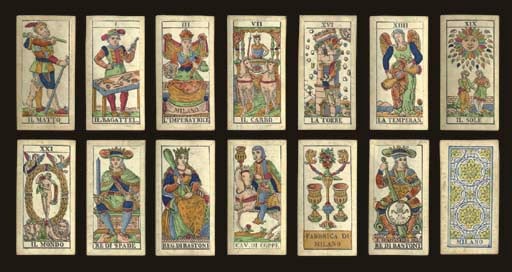
Italian Neoclassical Tarot These 78 cards are based on an Italian deck by Ferdinando Gumppenberg which date from approximately 1810. There are at least two editions that reproduce the original deck. The one I show below is titled Tarocco Neoclassico Italiano and was published in 1980 as a limited edition of 999 by Edizioni del Solleone. The other edition, which is nearly identical, was printed in 1995 by Lo Scarabeo and titled Antichi Tarocchi Lombardi. The designs on these two decks are the same, although there are a few minor variations which reveal the fact that most of the cards are reproductions taken from two instances of the original 1810 designs. Here are two cards that show some of these minor differentiations. The main giveaway is the Ace of Swords, showing different tax stamps for each reproduction. The other example shows that the two Death cards are actually from different illustrations. But this card is the one exception to the fact that the line illustrations are identical on every other card. Apart from Trump XIII, the only artistic difference between the two decks is a slightly different coverage of color and occasional hue differences, again implying that these were from two originals each painted or stencilled by hand. Both originals used the same black plates (except for the Death card) as evidenced by the same scratches and etching anomalies appearing in both reproductions. The Solleone edition shown here is printed on uncoated stock which looks and feels great; the Lo Scarabeo edition is printed on a coated playing-card type stock and has a somewhat better line quality. |
|
There are some artistic features in this Gumppenberg deck which set it slightly apart from its contemporaries.
The figures are elegantly engraved and well composed within the spaces of the card. This must have stood out as
an attractive variation, since many of the Italian decks of its time were less refined in illustration and the
figures so often crowded for space. The pip cards are a bit unusual since they use arrangements and suit symbols
that are much more like Spanish decks than Italian ones. A nice touch is the finely engraved beaded border on each
card. The Lovers card differs from usual renditions by switching the roles of the man and the woman. It makes me
wonder if the intent of the artist was to show two men vying for the affection of the same woman, or to show the
power of a woman who has command of the playing field! That idea may not be too far fetched considering there are
Sicilian decks dating from around the same period which show a man next to a woman holding the arrow in her own
raised hand, as if she is in control. |
|
Review by Mark Filipas, 12/11/99 |
Review Copyright © 1999 Mark Filipas
|
|