|
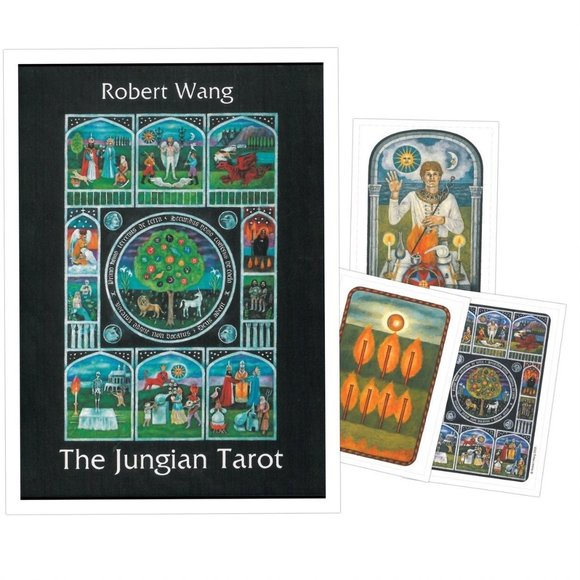
The Jungian Tarot The 78-cards of the The Jungian Tarot were painted by Robert Wang in 1988 and printed by AGMuller. Wang is also the artist of the Golden Dawn Tarot, published ten years earlier. His artistic style is clearly improved in this deck, with better renditions of the human form and more detail overall. Many of the paintings are quite beautiful, and there is a lot of symbolism in the Major Arcana. One detail that is unusual for any Tarot deck is that there are no titles or words anywhere on the cards – the images are meant to stand alone as pure expressions of the Jungian archetypes. |
|
Also emphasizing this right-brain mode are the beautiful mandala patterns which appear at the bottom of each Trump. These are reminiscent of the glyphs which appear in the Knapp-Hall deck, and Wang describes their purpose in much the same way that Hall did. Wang writes that “The Mandala, a ‘magic circle’ used as an aid to contemplation in the East, is a more graphic way of suggesting the energies of the many archetypes connected to each card.” Along these same lines, Wang goes on to say that |
|
The Jungian Tarot is a very flexible device which can be used with any system. There are no captions on the
cards, either to distract in meditation, or to impose a specific sequential order. Readers are free to apply whatever
interpretive programs they may consider appropriate. |
|
This deck explores the connections between the archetypes of Tarot and Jungian psychology, adding up to some
very new interpretations for both the Major and Minor arcana. For example, The Magician (shown at top-left)
is named the Son, and The High Priestess (shown next to him) is named the Daughter. These
two cards represent the Animus and Anima, the contrasexual components within Woman and Man respectively.
Wang suggests that a woman may relate to The Magician as a symbol of her own inner masculinity and her quest
for self-discovery. Men may feel a corollary relationship with The High Priestess, who represents for him
archetypal femininity and the knowledge of the heart. The mask which she holds represents the persona which
usually hides the inner self. |
|
The Minor Arcana has a logical structure which assigns each Sephirah to its corresponding numeric card. These
Sephirah manifest through each suit of Wands, Cups, Swords and Pentacles, which respectively correspond to the
four qabalistic worlds of Atziluth, Briah, Yetzirah and Assiah. Therefore one sephirothic sphere is illustrated
on each pip according to its corresponding qabalistic color. These 40 color attributions are those devised by the
Order of the Golden Dawn. So the Ten of Pentacles (shown above) would signify Malkuth in Assiah depicted
as a black sphere. |
|
Certainly, there are a few surprises when the Minor Cards are attributed in this way. A good example is the
Five of Wands, which has been called “Strife.” But when the Five of Wands is related to Mars in Aries, it is seen
to be a card of tremendous creative energy, of originality and of courage. It is a card of independence, of success,
of popularity, and of outgoing force which may be rapidly expended. |
|
Wang’s book also outlines a 34-week course of study, consisting of 22 weeks of Self Discovery through
the Major Arcana, 4 weeks of Personality Analysis through the court cards, and 8 weeks of Situational
Analysis through the Minor Cards. |
|
Review by Mark Filipas, 11/24/00 |
|
(1) See, among other sources, Aryeh Kaplan’s Sefer Yetzirah, pp.80–82 Images Copyright © 1988 Urania Verlags AG, Review Copyright © 2000 Mark Filipas |
|
|