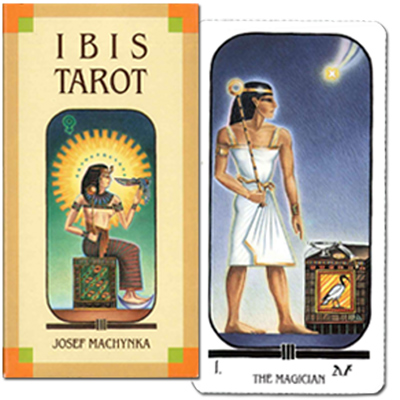
Ibis Tarot
Josef Machynka, 1991

The 78-card Ibis Tarot, published in 1991 by AGMüller, represents an Egyptian Tarot pattern first illustrated by M.O. Wegener in 1896. The coloring of the deck makes it one of the more attractive versions of this pattern. It is also one of the most faithful, even though it was painted nearly 100 years after the original designs. Josef Machynka actually based his cards on designs found in a 1901 book titled Practical Astrology, unaware that they were taken directly from the earlier designs of Wegener. Those drawings were published as a deck in 1978 by AGMüller under the name Egyptian Tarot(1). Machynka is also the artist of the 1986 Eclectic Tarot, another deck which pays reverence to early occult traditions.


The name Ibis refers to the bird associated with the Egyptian god Thoth, who instructed mankind in the sacred arts of language and hieroglyphics. It is Thoth, therefore, who is sometimes called the author of the “Book of Tarot”. The ibis bird can be seen on the side of the Magician’s table, shown above. Machynka describes it there as symbolizing “the divine power worshiped by the Magician.”

In addition to the Wegener drawings, there is another important source for the Egyptian Tarot pattern: the descriptions by Paul Christian
(2), which appear for the first time in his L’homme rouge des Toileries of 1863(3). This text describes each Trump image as they purportedly appeared in ancient Egypt. His accounts seem to have been taken at face value by many occultists of the time, even though those accounts were historically groundless. We might surmise whether Christian conceived these descriptions himself, or if he fabricated his fictitious histories as an excuse to document the ideas circulating in the occult circles of his time. There are certainly a few details which can be found earlier in the occult writings of Christian’s contemporary: Éliphas Lévi. In any case, much of Christian’s elaborate symbolism would find its way into the occult decks that were soon to follow, including those by Falconnier, Papus, Wirth, and even Waite. Numerous details in their decks are found for the first time in the text of Christian. But the Falconnier-Wegener designs were the first to bring those 1863 descriptions to life.

It was Christian’s text which introduced Egyptianized trump titles. The Fool was renamed The Crocodile (shown above), and shows a blind man about to trip over a fallen obelisk and into the open jaws of the creature. The blind man and the lunar eclipse symbolize the initiate walking in the darkness, suggesting that we are subject to the dangers of our own actions unless we learn to use alternative senses.

The Magician (shown above) symbolizes willpower and unity, illustrating the Hermetic maxim as above, so below. The suit symbols on the table, made explicit for the first time by Lévi and the Egyptian pattern, are reminiscent of the solitary items seen on the Visconti-Sforza card. The Magician’s white tunic, serpent belt and golden headband are details first specified in Christian’s text.

Lévi described the Magus as man applying universal science: “The first letter in the alphabet of the sacred language, Aleph, represents a man extending one hand towards heaven and the other to earth. It is an expression of the active principle in everything(4).” Christian’s text is more explicit: “The Magus holds in his right hand a golden sceptre, image of command, raised toward the heavens in a gesture of aspiration towards knowledge, wisdom and power; the index finger of the left hand points to the ground, signifying that the mission of the perfect man is to reign over the material world. This double gesture means that human will ought to be the earthly reflection of the divine will, promoting good and preventing evil(5).”

Many of the symbols we have come to associate with The High Priestess (shown in top row as The Gate of the Sanctuary) originate with the Egyptian pattern. The pillars behind her and the solar cross over her breast appear for the first time in Christian’s text. Other details are first introduced by Lévi: “In the hieroglyphic work of Hermes, being the Tarot or Book of Thoth, the duad is represented either by the horns of Isis, who has her head veiled and an open book concealed partially under her mantle, or otherwise by a sovereign lady, Juno, the Greek goddess, with one hand uplifted towards heaven and the other pointed to earth.”

The Hermit is here called The Veiled Lamp (shown above); his concealment of the lantern symbolizes discretion. Machynka explains his beard as a symbol of wisdom, and his walking stick as “the staff of Anubis, sign of his inner pilgrimage through the worlds beyond the physical.”

A sphinx is seated at the top of The Wheel of Fortune. This idea originated with Lévi, although some authors believe that the non-descript creature in the Marseilles version is a sphinx. Other details are introduced by Christian: “On the right Hermanubis, the Spirit of God, strives to climb to the top of the wheel. On the left Typhon, the Spirit of Evil, is cast down.” Wegener’s design replaced the figure of Hermanubis with the Egyptian goddess Bastet, a goddess with the head of a cat.

Machynka wanted to create a more beautiful version of the original designs that he admired. He also wanted to correct several inaccuracies found in those designs so that they would reflect our current state of knowledge. He redesigned, for example, the proportions of all human figures in the deck to accord with Egyptian paintings. He also made corrections to the hieroglyphic inscriptions, and replaced other pictorial items with elements more proper to Egyptian culture.

Falconnier-Wegener did not include designs for the Minor Arcana. These seem to appear for the first time in Practical Astrology, and are the pattern followed in the Ibis Tarot. The suit symbols were arranged by the original designer into geometric patterns which imply numerological meanings.

Machynka’s Minor Arcana are beautifully enhanced by his addition of painted backgrounds for all 40 pip cards. Each painting is unique, with skies and landscapes that reflect the meaning of the suit. The suit of Sceptres has green, open countryside symbolizing the creative force and the potential for growth. The contrasting suit of Cups, representing feminine receptivity and depth, shows bodies of water in various states of motion. The airy suit of Swords uses desolate landscapes to symbolize challenges and stamina. The suit of Pentacles has backgrounds of fertile farmland and tilled soil. Machynka based the coloring of the cards on the Sepher Yetzirah and on the astrological data in Practical Astrology.

The Ace of Wands, shown below, is similar to the one on Trump VII, but the circle and triangle have exchanged places. Machynka describes the charioteer’s staff as symbolic of his dominion over the three realms of body, mind, and spirit. Christian’s text is more explicit: “The scepter, crowned by a triangle, symbol of the Spirit, by a square, symbol of Matter, and by a circle, symbol of Eternity, signifies the perpetual domination of the Mind over the forces of Nature.”

The sigils at the bottom of the Trump images, which have been reproduced without explanation on numerous decks since then, are referred to as the alphabet of the Magi. As far as I can tell, they appear for the first time in Christian’s Histoire de la magie, although he claims they were used in divination by Cagliostro
(6).

The Ibis Tarot is not only an artistic deck, but one which represents the earliest occult Tarot traditions. It is usually available through U.S.Games Systems.


Review by Mark Filipas, 2/2/01

(1) This deck was distributed by U.S.Games Systems in 1980
(2) One of many pseudonyms of Jean-Baptiste Pitois
(3) These are virtually the same descriptions as in Christian’s 1870 work
Histoire de la magie
(4) All quotes by Lévi are from his
Dogme de la Haute Magie, Chapters 1 and 2; published 1856
(5) All quotes by Christian are from his
Histoire de la magie; published 1870
(6)
Ibid., pp.147–149

Images Copyright © 1991 AGMüller, Review Copyright © 2001 Mark Filipas