Your Legal Resource
Romeo And Juliet Tarot Deck Revisited
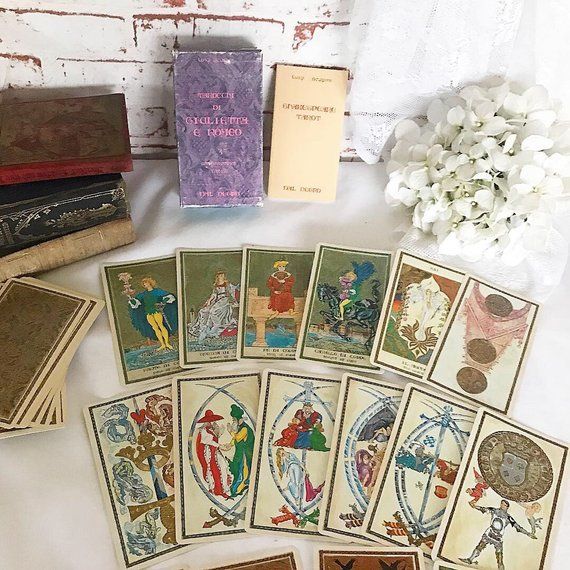
This deck is usually called by its Italian name, �Tarocchi di Giulietta e Romeo�, or the Tarot of Romeo and Juliet. For some reason, though, the English sides of the package and the booklet call it the �Shakespeare Tarot�. (This is not the deck by Ashcroft-Nowicki, whose deck is called �The Shakespearean Tarot�.) Despite the Italian name, the deck illustrates a wide variety of Shakespearean scenes and characters, not just those of Romeo and Juliet. This was a pleasant surprise for me since it gives the deck�s subject matter a wider appeal.
Those familiar with the Medieval Scapini Tarot will recognize the artist�s distinctive style. An interesting feature of these paintings is that there is a gold-leaf type of ink used with other, more subdued, colors in the backgrounds, simulating a look that expensive medieval decks must have had. The gold, as well as a silver metallic, is used as highlights in the foreground images too. But these are not at all overdone. This is such a colorful deck that I think the gold, silver, and earth tones that are used help to harmonize the rich palette. Fortunately, the cards are large, a very nice size for us to appreciate all the details and textures of the art.
The Wheel of Fortune shows King Lear at his triumph and at his devastation. �Goneril�s and Regan�s fortune is spinning fast, the only fixed ax of the Wheel of Fortune is Cordelia�s, pure heart.� The Sun card shows the love and surrender between Romeo and Juliet. Having cast some of their clothing to the floor, they have crossed a threshold and are joined together within the heat and light of the Sun. The magician, of course, is William Shakespeare himself, holding �the strings of Romeo�s and Juliet�s lives, who are about to act out their own script in a puppet Theatre of the World, a Lilliputian Globe. But it�s uncertain whether the theatre is a miniature, or the puppeteer a mighty giant.� Scapini describes the figure in the World trump card as a fairy-like creature perhaps from the world of Oberon, who opens the symbol-rich curtain of the background pattern to reveal �the clearer and more material light of the Minor Arcana".
The Queen of Swords is represented as Lady Macbeth and is inspired by J.P.Sargent�s 1888 painting of the Shakespearean actress Ellen Terry. The women in the background are the three hags of the moor. Standing before the Three of Cups are the Chantilly Graces, envisioned by Scapini as little girls. His cups are decorated with grapes (Plenty), palm leaves (Truth), and foxglove (Healing). Tybalt is shown storming forward onto the stage in the Seven of Swords. The Hanged Man is acted by Hamlet, whose face is a self-portrait of Scapini. Beneath him is Ophelia�s body floating in the stream and surrounded by symbolic-laden wildflowers.
The �small� booklet that comes with this deck is so physically thick that it is bound like a nice paperback book. It is printed in Italian and English and is wonderfully written by Scapini. Every card is described by him, giving his commentary, explanatory scenes from a chosen play, and often a corresponding quote or two. Some of these descriptions are quite detailed. His love of Shakespeare, Art History, and the Tarot are all apparent and amazingly intertwined.
Author: Luca Scapini
Number of Cards: 78
Card Dimensions: 5.75" x 3.25"
Publisher: Dal Negro, Italy
Brochure with instructions