Elemental Tarot
Caroline Smith and John Astrop, 1987

The Elemental Tarot is a book and deck set which was originally published by Dolphin Doubleday in 1987. The entire set is gorgeous.

My first copy of this deck, however, was the recent edition by St.Martin’s Press. While this edition is readily available at the time of this writing, its quality is inferior to the original. The biggest offense is the pixelization of lines; every image was digitally re-separated but the line resolution was not high enough for the printing process. The result is a noticeable pixelization of the linework, similar to what one might see on a computer monitor.


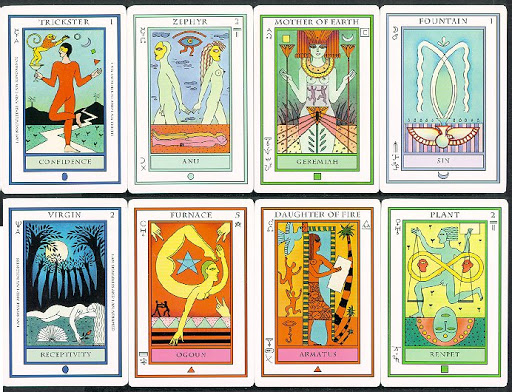
The new edition also contains newly typeset letters in the bottom panels of the Trumps. The original, as shown here, has Trump titles which are larger than those on the suit cards. I can only assume that the new publishers felt the larger titles would appear visually inconsistent. But in order to insert these new titles, the panel behind them had to be digitally recreated to cover the old titles. Unfortunately these new panels use a flat color and do not have the charm of the original mottled colors as shown here.

I was able to order an original edition from the authors themselves. John responded with a very nice reply and commented that he and Caroline were also disappointed with the St. Martin’s edition. They tried, but were unable, to convince the publisher to fix the problems. Since this edition has remained on the shelves I have to wonder how noticeable these defects are to others. The pixels are certainly noticeable at close range, but I found the effect still distracting when the cards were laying on my table.

Now that I’ve criticized the current edition, I can praise the original. The first thing to note is the excellent slipcase packaging which houses a boxed set of cards and a hardbound book. I wish more publishers would include the deck boxes for cards within a book and deck set, just as they would if the cards were sold by themselves. The lack of such a box is a pet peeve of mine because the larger packaging is never a convenient way to store a deck that one wants to handle on a regular basis, and hardly protects the cards once they are unwrapped. The 128-page book which comes with this set is beautifully clothbound and includes small black and white illustrations of all 78 cards. Each card has one page devoted to its description, its astrological and religious correspondences, and its divinatory meanings. The text is not extensive but is well-written and well-presented.

The deck’s unique artistic style is unlike any other deck I can think of (except other decks by this artist), nor is the subject matter in any sense a Waite-Smith clone. Stylistically it is contemporary, geometric, and quite different from the style of art that I am usually drawn to. In fact I initially wanted this deck not for its artwork but to help my understanding of the minor arcana – which this deck is very helpful for. But the illustrations themselves quickly grew on me. The colors are vibrant and range from extremely saturated to light washes, reproduced beautifully on sturdy cardstock.


The designs are very symbolic, but in a way that is different from occult decks. The Trumps even use some new visual metaphors. For example, the High Priestess is called the Virgin, shown at the top of the page. Instead of her usual seated position, she is here shown lying down, but most of the usual elements of the card are here: the moon, the book, the two pillars and the trees which form a veil behind her. She is exposed to the stars, but listens also to the earth. The rose which she holds has pricked her finger, and there is one drop of blood. The whole image is a metaphor for Receptivity, the primary keyword of this card.

The Hermit has been re-titled The Shaman, shown below. The ornament around his neck is made up of the symbols used in this deck for the five elements. Instead of the lantern which usually lights his path, he is shown at the top of a mountain standing above dark clouds, the design symbolizing his ability to see clearly that which is hidden from others. His hands touch the canopy of the sky, and below him is the Egyptian symbol of the ka.

There are several cues printed within the borders of each card. Corresponding elements are symbolized at the bottom by one of five geometric shapes. These five shapes are actually the Tattwa symbols sometimes used in visualization exercises, though reference to this tradition is not mentioned in the text. The Trumps are noted by an egg shape which corresponds to Spirit, the suit of Fire by a red triangle, Air by a blue circle, Water by a silver moon, and Earth by a green square. Each card is also assigned a pair of planets which is meant to give additional meanings. This system of correspondences does not use the twelve zodiacal signs, but instead uses the ten planets, the midheaven, the ascendant, and Moon's node. The total pair combinations possible equal seventy-eight.

The twenty-two major cards are titled at the top, and supported by a descriptive keyword in the color bar at the bottom. Within the side margins are lines from a Gnostic poem titled The Thunder, Perfect Mind. This text was one of several documents comprising the Nag Hammadi discovery in 1945. The poem is highly mystical and often uses logical contradiction to describe the nature of higher states of existence.

Each minor arcana card includes the name of a god or goddess from a variety of cultures. Many of these names I had never seen before, which simply makes the deck all the more exotic to me. I just wish there was more information about them in the accompanying book.

The designs are vertically divided at the point of the golden section, which John explains is incorporated into Caroline’s illustrations. This proportion can be found by comparing the lower area (bottom of colored title bar to dividing line) to the entire area. Other decks, such as the Egypcios Kier and various Egyptian decks, use similar divisions to suggest the three worlds of unconscious, conscious, and superconscious. The card’s symbols are then interpreted according to the area in which it appears.

Caroline’s use of this division is an aesthetic decision. But given the diagrammatic style of her designs, such divisions could suggest interpretative insights. The Six of Earth, Harvest, could symbolize that the energy of the Sun originates in the upper spheres of spirit, and reaches down to nourish the flowers of conscious thought and emotion, those that are above the surface. The Goddess, however, extends throughout all worlds. The solar disks on her hands could suggest that her energy must reach into the deeper subconscious in order for greater plants to mature. The lower area of The Moon card shows a body of water; nothing visible beneath the surface of the subconscious. Not only are its depths unseen, but what is visible are mere shadows. The hand could be seen as our holding up of psychological masks which prevent our contact with higher lunar energies. Seen as rising from the subconscious realm, the mask may represent our own projections. The ancient archway emerging from the water may be the signposts, such as dreams and visions, which occasionally break through to our outer awareness.

The titles at the top of the forty numeric cards bring us to the deck’s central theme: the elemental processes which lie behind the minor arcana. First, the deck emphasises the elements themselves – Fire, Air, Water, Earth – bringing these associations to the surface rather than buried behind traditional suit symbols. Second, each pip number expresses one of ten progressive elemental aspects. The titles describe this combination of aspect and element as objective forces of nature. This system is both logical and charming; the titles not only depict nature’s own metaphors but they are words which evoke mental images.

The book states that “The Elemental Tarot is a synthesis of the best interpretations sifted from the plethora of obscure and sometimes almost incomprehensible decks and books of the past and present.” My own impression is that the details of this deck have been distilled from a large body of material. Because of this, the deck can give useful insights when comparing it with other decks, and is especially helpful in understanding the archetypes of the minor arcana. I like the fact that visual words are used, such as Clay (the Four of Earth), Furnace (the Five of Fire), and Lake (Nine of Water), as opposed to titles which express subjective emotional states (such as Happiness and Sorrow). The court cards are also objective. The royalty of the Fire suit, for example, are renamed Daughter of Fire, Son of Fire, Mother of Fire and Father of Fire.

This original edition is scarce, but well worth looking out for. The St.Martin’s edition is currently easy to find. The authors John and Caroline have additional information at their beautiful Elemental Tarot website. This site provides images and meanings for every card in the deck, as well as additional information and downloads. (The authors may still have a few original editions left; check their web site for info.)


Review by Mark Filipas, 8/11/00

Images Copyright © 1987 Dolphin Doubleday, Review Copyright © 2000 Mark Filipas