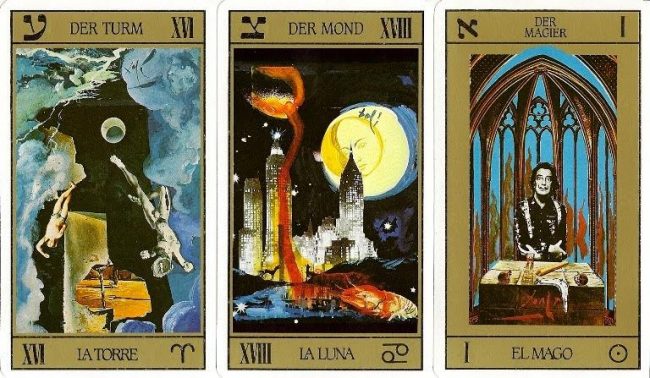
Dali Universal Tarot
Salvador Dali, artwork 1984

This 78-card Tarot deck is by the surrealist painter Salvador Dali. His renowned flamboyance can be seen in the way he has added his abstract signature onto the cards, incorporating them into each design. The deck was published by Distribucions d’Art Surrealista and Comos Naipes of Spain in 1984, the year of Dali’s eightieth birthday.


Given Dali’s own talents, it is surprising that this deck consists of collage compositions which incorporate the works of other artists. Dali adds his own touch to each design by using washes of color and semi-abstract shapes. In some cases, these forms seem strangely inconsistent with the rest of the artwork; in other cases, his additions create something new and homogenous. For example, Dali adds a very simplistic figure next to a detailed painting in The Fool (shown above). His version of The Heirophant, however, is much more attractive even though he adds only a simple green background and painted halos.

There is a book by Rachel Pollack called Salvador Dali’s Tarot, published separately from the deck in 1985. The book provides a commentary on every card, with beautiful full-color reproductions of each design. I was very disappointed, though, that the majority of Dali’s collage sources are left unidentified. Pollack has subsequently explained that she was not able to interview the aging Dali about his deck in the years between its completion and her book, and that her commissioned deadline was extremely tight. Therefore the blame for this inadequacy may rest more with the publisher Salem House than it does with Rachel. She was fortunately able to enlist the help of a curator at the Amsterdam Modern Art Museum to help her identify a few of the art sources in the collages.

Pollack points out that there are two motifs which Dali used throughout the deck: the butterfly and the linear figures. Both motifs can be seen in The Fool, shown above. On the left is the figurative image of a person raising a staff above the Fool’s head. The staff reflects the shape of Hebrew letter Shin, and the little booklet for the deck explains that it “symbolizes desire and will.” The figure is also painted in red which may represent the element associated with this Hebrew letter: Fire. A blue butterfly can be seen over the belly of the rider, and a pattern of butterfly wings can be seen in the blanket which covers the horse. The booklet explains that “The intellectual plane is symbolized by butterflies, expressive of irrationality and the alienated soul, the consequence of fickleness and disorder.” The Fool himself is not identified, but appears to be a depiction of either a saint or Don Quixote. The “prophetic meaning” given for this card is the expiation of disorder.

Shown above is The Lovers, which incorporates a painting by Gossaert of Adam and Eve. The serpent himself takes the place of the Tree of the Knowledge of Good and Evil, and the fruit of the tree is represented by the shape of an apple. The booklet describes the serpent as symbolizing both wisdom and lies, which might be interpreted to mean that Good and Evil are two sides of the same Truth.

The meaning of Trump X is Changes in Fortune. The man at the top of the globe signifies Time, who wields the sword of Destiny. The wheel itself is a solar calendar shown as two complimentary halves, much like the yin and yang. Two serpents of Good and Evil climb upwards from each side of the globe.

Trump XVII is The Moon. This modern version of the card is based on an unidentified photograph of the New York city skyline. The sillouhette of two howling dogs can be seen in the distance, and the two towers have become two skyscrapers. In the foreground is a lobster, and above him is a moon with a woman’s face. The booklet describes the lobster as symbolically similar to the Egyptian scarab beetle, representing “the transformation of the superficial into the useful.” The entire design implies that, in spite of the dressings of ‘civilization,’ we are still creatures of nature and primal drives.

Each of the 56 Minor Arcana cards are also collaged artwork. The little booklet for the deck has no text whatsoever to describe these 56 cards. Many of the compositions are original, although others show the influence of the Waite-Smith images. Painted into the designs are the four suit emblems: Wands are painted as green staves with small leafy shoots, as seen in the King of Staves above; Swords are depicted as blue double-edged broadswords; Cups are painted as yellow lotus-patterned chalices, as shown in the Four of Cups above; Coins are all illustrated as flat disks of yellow with red pentagrams and borders, as shown above in the Ace of Pentacles.

The Dali Universal Tarot is a comparatively expensive deck, although its packaging was given special attention by the publishers: the cards themselves are edged in gold foil and the sturdy box which hold the cards is encased in a burgundy velvet slipcase. The deck can currently be purchased from several online bookstores.

Review by Mark Filipas, 12/8/00

Images Copyright © 1984 Distribucions d’Art Surrealista and Comos Studio
Copyright © 2000 Mark Filipas