The Alchemical Tarot
Robert Place and Rosemary Ellen Guiley, 1995

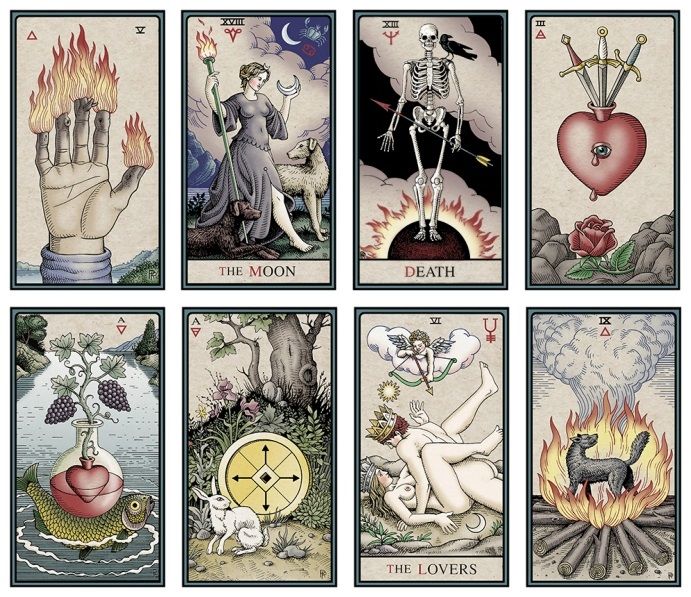
The Alchemical Tarot is one of my favorite decks because of the logic behind its symbolism and its beautifully rendered artwork.

Robert Place’s designs capture the charm of old alchemical engravings. Artistic preferences may be subjective, but it would be hard to imagine anyone not liking these crisp and colorful illustrations. One of this deck’s strengths is the consistently accurate rendering of human proportions, helping it to stand out among many decks being published today. The compositions are also beautifully balanced and appear to have been designed by someone trained in the graphic arts.

This deck borrows from the symbolism of old Renaissance alchemical imagery. Already sharing the same dreamlike and surrealistic quality as the Tarot, alchemical drawings were proliferating during the time the cards were taking form in the early fifteenth century. The book which accompanies this deck gives the original alchemical sources from which each illustration was either derived from or inspired by. It is surprising, given this large body of sources, that the authors have synthesized such a harmonious whole. Adding to the challenge is the fact that most alchemical texts are written in a convoluted and confusing style. This deck extracts essential principles of the alchemical Opus and arranges them according to principles of Pythagorean number symbolism.

The stages of the alchemical process are primarily represented through the Major Arcana. The Fool stands for the neophyte alchemist, The Magician is the prima materia, or the first ingredient we begin with, and The World represents the Anima Mundi, or final transformation of the base metal into the gold of Divine Consciousness. The High Priestess (above) makes a gesture of silence, for she represents mysteries, and the language of archetypes. Her book is closed, and, like the moon and the tide, she evokes the rising of hidden wisdom inside of us. She represents the stage of Dissolution, the alchemical process which dissolves and separates the prima materia into its constituent elements.

The image for The Empress was inspired by a 1628 drawing by Johann Daniel Mylius. As The High Priestess is that aspect of the Goddess who nurtures our inner world of Gnosis, The Empress (above) is the aspect of Goddess who nurtures the outer realms of Nature: animal, symbolized by the child; vegetable, symbolized by the plants and trees; and mineral, symbolized by the rocks and mountain. She represents Nature as the alchemical vessel, within which the Philosopher’s Stone is being created.

The Minor Arcana are fully illustrated, and each suit is introduced by a symbolic animal. The Ace of Coins (above) includes the earth-dwelling hare, archetypal guide to the underworld; the Ace of Vessels shows a fish, messenger of subconscious forces; the Ace of Swords depicts the mythical Basilisk, symbol of Wisdom and creature which devours the initiate; and the Ace of Staves shows the Salamander standing within her flames.

The numbered suit cards combine traditional Tarot meanings with Pythagorean symbolism. In my opinion, this approach has helped clarify the essential numeric and elemental concepts of the Minor Arcana. The Four of Staves (above) brings together the structure and endurance of the number four to the suit correspondences of the fire element, relating to initiative, creativity, and passion. The staves are depicted as four torches which create a sacred space in which the couple are making a commitment. It symbolizes sustained energy, enthusiasm, and the formation of a creative or spiritual design. The Four of Coins (above) is perhaps the epitome of stabilization, as the structuring aspect of the four finds itself in the suit of earth. It shows an older man burying four coins in the ground, and looks like it could equally be depicting the foundation being laid for a building. The strength (and weakness) of all the fours, including The Emperor, is that they are not easily moved. This card could be seen both as preserving your assets and grounding your energies, as well as too much concern over physical things and unhealthy attachment.

In spite of being steeped in alchemical tradition, this deck retains the symbolism and feel of the traditional Tarot. In fact I suspect that the cards could be easily appreciated by taroists who have little prior knowledge of alchemy. The Alchemical Egg is the artist’s web site, which includes more details about this beautiful deck.


Review by Mark Filipas, 6/23/00


Images Copyright © 1995 Rosemary Ellen Guiley and Robert Place,
Review Copyright © 2000 Mark Filipas