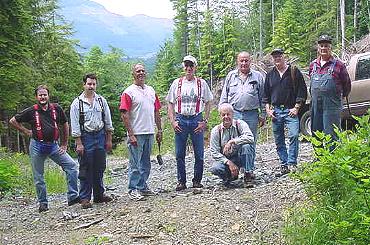
The Camp 2 site is dedicated to historical logging activity, research and information of logging, in the days of steam. On this site you will find many interesting subjects relating to: logging, steam equipment, logging railroads, models, conventions, "Donkey hunts", interviews, field trips and research, as compiled by the author of this site and the book
"IN SEARCH OF STEAM
DONKEYS", by Merv Johnson.
To the people who used them, steam donkeys and other logging equipment made their livelihoods possible. From its beginnings in the 19th and 20th centuries, to its heyday in the twenties and thirties, to its decline and extinction in the 1950s, steam logging captured the imaginations and hearts of generations of the people who were there. The steam donkey modernized logging methods and greatly improved productivity when it was introduced to the industry to replace older methods such as, teams of oxen, horses and gravity fed water flumes, to mention a few. Before the advent of log trucks, these "logging shows" worked hand in hand with logging railroads, to transport the logs to market, from the vast forests of the Pacific Northwest. The steam donkey was the muscle and machine that moved the logs cut by the tree falling crew, to a central area, called a "landing". From there the logs were loaded onto rail cars for transport out of the woods by the railroads. this system of logging used a vast array of cable to both hold the "spar tree", used to lift the logs off the ground, and to support the pulley blocks that were used to haul the logs in.
This web page will attempt to be both informative as to the methods and history of steam logging, as well as provide information into current events relating to steam donkeys, and logging in miniature, with scale machines.
|
"Donkey", An endless variety of steam, gas, diesel, or electric power plants, plus drums to hold wire rope; all used to haul logs from the woods, to load at landings, move equipment, rig up trees, and in the old days , to lower cars down inclines... The most common makes were Seattle, Portland, Tacoma, named after iron works in those cities, Vulcan, Smith and Watson, and others named after the company which built them... 26 different types of steam donkeys were built in the Pacific Northwest by one firm alone. In 1913, one company built 51 donkeys in a 49 day period, all sold before they left the plant to fill rush orders...Donkey was a term originally applied to a little steam engine of less than one horsepower. A man by the name of Dolbeer adapted a ships capstan for his logging rig, and it is possible that he also brought along the seafaring term for the engine itself.
Steam logging equipment has marked our journey through time as the West Coast became part of national industrialization. The use of steam donkeys in particular were machines that typified the heyday of logging in the West, machines whose power and grace left a mark on the men as well as the mountains. Those steam donkeys that still exist create a three dimensional scrapbook of history. Donkeys are, in fact, a link to the "glory days of logging," as one writer put it. Those who worked the "big woods" around the steamers speak of a time, now gone forever, with reverent nostalgia. However, it is not necessary to be a steam logging equipment lover to morn the demise of steam donkeys. You don't even have to like donkeys or logging history, but it is important to realize that:(1) of the thousands that were built during the age of steam, only thirty some remain in Oregon. (2) Of those remaining in Oregon, few are anywhere near operating condition. (3) Only a few donkeys built during this time period up to 1930, were not steam powered. How could these machines have disappeared so fast? Why have the traces been almost totally erased? Were the Willamette Two-Speeds, the Lidgerwood skidders, and the duplex loaders only devices used to transport logs from stump to railroad, useful then, but now forgotten? These steamers were central to the character of mechanized logging of the time. Each machine had its own personality, its own idiosyncrasies, unlike today. (Today, the engineer climbs into an enclosed cab and pushes and electric starter.) The donkey was unique in so many ways, even in terms of its own sounds. How many know what a steam donkey sounds like? Even among steam railroad fans, few are familiar with the powerful sound of hot, dry steam powering a 12X14 yarder pulling at high speed. It is unlike any other. The power, the speed, the vibration, the smell were all a part of it. For some today, the odor of crude oil, freshly cut wood, or a frying sound of lubrication, will trigger an instant nostalgic time machine. Memories of those days we prefer to recall are of a time of glamour, accomplishment, humor, and hard work, in spite of facing danger, pain, and sometimes death. To understand how deeply the steam donkeys cut into the logger's personal history, it is only necessary to talk to those who were there. But one must hurry, for time is taking its toll. The number is diminishing. Some died before they could be contacted about the history of donkeys remaining in Oregon. Many of the stories still remain however. I remember my father, Lee Johnson, warming toast over the firebox extension. I remember Lee steam-cleaning his overalls with his home made washing machine connected to a donkey. I remember riding in a '41 Chevy pickup between the shoulders of two loggers who were reminiscing about Consolidated Timber Co. which had shut down its steam a year previously. Both of them had spent most of their lives on and around donkeys. Their vivid descriptions of how yarders sounded with 225 lb. of steam in a hard pull, how the firebox door used to puff after a turn of logs came in, and how one could tell a "whistle punk" by his style of blowing whistles brought tears to my eyes that day. Lets zero in on a part of us, the part that doesn't want to sever these roots. One way to prevent that separation of ourselves from our past is a revival of the romance of steam logging. |
Below you will find the navigation bar to look at subjects related to logging, both historical information and one of our favorite past times, logging in miniture with scale eqipment. This site has only recently been posted to the web. Some pages are not complete yet so keep checking back to see additions to the site. We are also interested in any old photos or stories relating to logging and railroads, so feel free to drop an email if you have some material for the site.
/ HOME / DONKEY SECTION / LOGGING LOCOMOTIVES / CALENDAR OF EVENTS / LOADING / YARDING / LARGE SCALE DONKEYS & LOCOMOTIVES / DEER ISLAND LOGGING SHOWS /STORIES & COMMENTS / LINKS TO OTHER SITES / CREDITS / LOGGERS LEXICON
MAIN PAGE
Due to spam and unwanted Email, I am requesting that any Email sent from someone I have not heard from before, should include these words in the subject line. "STEAM DONKEY LOGGING" If you do not enter this phrase on the subject line, your Email might be deleted!