Back to The Ecology Plexus Page...
Back to The Plexus Home Page...


Creating Bayesian Network Models
in Ecology

Bruce G. Marcot
updated 21 September 2009


Introduction to Bayesian Network Modeling

What are "Bayesian belief networks?"  ... 
a harmless, simple introduction with virtually no math.
[PDF version but without the animations]


Papers on Bayesian network modeling

 
Bayesian network modeling of future polar bear habitat & populations:  

Amstrup, S. C., B. G. Marcot, and D. C. Douglas. 2007. Forecasting the range-wide status of polar bears at selected times in the 21st century. Administrative Report. US Geological Survey, Anchorage, Alaska. 126 pp.  PDF (4.4MB)  
    Note: part of a special science series by USGS on polar bears.  See news article here.

Amstrup, S. C., B. G. Marcot, and D. C. Douglas. 2008. A Bayesian network modeling approach to forecasting the 21st century worldwide status of polar bears. Pp. 213-268 in: E. T. DeWeaver, C. M. Bitz, and L.-B. Tremblay, eds. Arctic sea ice decline: observations, projections, mechanisms, and implications. Geophysical Monograph 180. American Geophysical Union, Washington, D.C.  PDF (4.4MB) 

Amstrup, S. C., H. Caswell, E. DeWeaver, I. Stirling, D. C. Douglas, B. G. Marcot, and C. M. Hunter. 2009. Rebuttal of "polar bear population forecasts: a public-policy forecasting audit". Interfaces 39(4):353-369.  PDF (235KB) 


Special issue section on Bayesian network modeling, in Canadian Journal of Forest Research:  

Marcot, B. G., J. D. Steventon, G. D. Sutherland, and R. K. McCann. 2006. Guidelines for developing and updating Bayesian belief networks applied to ecological modeling and conservation. Canadian Journal of Forest Research 36:3063-3074.  PDF (492KB)

McCann, R., B. G. Marcot, and R. Ellis. 2006. Bayesian belief networks: applications in natural resource management. Canadian Journal of Forest Research 36:3053-3062.  PDF (241KB)

McNay, R. S., B. G. Marcot, V. Brumovsky, and R. Ellis. 2006. A Bayesian approach to evaluating habitat suitability for woodland caribou in north-central British Columbia. Canadian Journal of Forest Research 36:3117-3133.  PDF (723KB)

Nyberg, J. B., B. G. Marcot, and R. Sulyma. 2006. Using Bayesian belief networks in adaptive management. Canadian Journal of Forest Research 36:3104-3116.  PDF (242KB)


Two-part series on use of Bayesian network modeling for characterizing species at risk, in Ecology and Society: 

Marcot, B. G.  2006.  Characterizing species at risk I: modeling rare species under the Northwest Forest Plan.  Ecology and Society 11(2):10. [online] http://www.ecologyandsociety.org/vol11/iss2/art10/ ... or article PDF (701KB) and appendix PDF (21KB)  

Marcot, B. G., P. A. Hohenlohe, S. Morey, R. Holmes, R. Molina, M. Turley, M. Huff, and J. Laurence. 2006. Characterizing species at risk II: using Bayesian belief networks as decision support tools to determine species conservation categories under the Northwest Forest Plan. Ecology and Society 11(2):12. [online]  http://www.ecologyandsociety.org/vol11/iss2/art12/ ... or article PDF (1.3MB)   


Other publications on Bayesian network modeling: 

Marcot, B. G.  2007.  Étude de cas n°5: gestion de ressources naturelles et analyses de risques (Natural resource assessment and risk management).  Pp. 293-315 in: P. Naim, P.-H. Wuillemin, P. Leray, O. Pourret, and A. Becker, eds.  Réseaux bayésiens (Bayesian networks) [in French]. Eyrolles, Paris, France.  PDF preprint in English, (252KB); PDF chapter in French (449KB); title pages.  

Marcot, B. G.  2006.  Habitat modeling for biodiversity conservation. Northwestern Naturalist 87(1):56-65.  PDF (236KB).  [Discusses various modeling approaches including use of Bayesian belief networks.]   
    Abstract published as:  Marcot, B. G. 2005. Habitat modeling for biodiversity conservation (abstract). Northwestern Naturalist 86(2):107.

Marcot, B. G., R. S. Holthausen, M. G. Raphael, M. M. Rowland, and M. J. Wisdom. 2001. Using Bayesian belief networks to evaluate fish and wildlife population viability under land management alternatives from an environmental impact statement. Forest Ecology and Management 153(1-3):29-42.  PDF (252KB).  [Also see below for more information on this publication and access to the models used]

Raphael, M. G., M. J. Wisdom, M. M. Rowland, R. S. Holthausen, B. C. Wales, B. G. Marcot, and T. D. Rich. 2001. Status and trends of habitats of terrestrial vertebrates in relation to land management in the interior Columbia River Basin. Forest Ecology and Management 153(1-3):63-87.  PDF
(544KB).


Textbook on Bayesian Network Applications:

Pourret, O., P. Naïm, and B. Marcot, editors.  2008.  Bayesian networks: a practical guide to applications.  Wiley.  428 pp.  

Available from Wiley and from Amazon.com.  See a synopsis, descriptions from the publisher and authors, and excerpts at Amazon.com.uk.  

See lots more about this book -- background, models and applications, new material -- at "Bayesian Networks ~ Applications" ... a website created by the book editors.   


Netica Models from Paper on Constructing Bayesian Networks

Marcot, B. G., R. S. Holthausen, M. G. Raphael, M. Rowland, and M. Wisdom.  2001.  Using Bayesian belief networks to evaluate fish and wildlife population viability under land management alternatives from an environmental impact statement.  Forest Ecology and Management 153(1-3):29-42.   
Download the paper (PDF, 443KB)

Models mentioned in the paper:

Note:  Download these models (they're ASCII files) by right-clicking on the following links.  To run these models you need the Bayesian network program Netica, available from Norsys, Inc., at:  http://www.norsys.com
Model 1: (from Fig. 1)
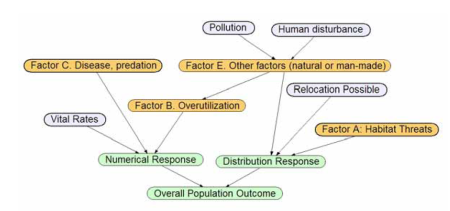
General structure of a Bayesian belief network (BBN) model for evaluating population viability outcomes of wildlife species, showing 6 shells of nodes.  See Appendix 1 for description of node names.  The state of nature nodes (shells 2-5) can depict parameters as multiple discrete values (as shown here) or as continuous values.

Figure 2:
Example BBNs depicting population response of a wildlife species, Townsend’s big-eared bat (Corynorhinus townsendii), in the interior Columbia River Basin, U.S.A., at 3 levels of geographic resolution.
Model 2a: (from Fig. 2a) - Site-specific BBN model:  relations of site-specific key environmental correlates (KECs);
Model 2b: (from Fig. 2b) - Subwatershed BBN model:  relations of subwatershed-scale KECs and their GIS proxies;
Model 2c: (from Fig. 2c) - Basin BBN model:  overall population outcome.


Other Examples of Bayesian Network Models

  
In addition to the Bayesian network models presented in the various publications listed above, other examples using the Netica modeling shell can be found here: 


Guidelines for Developing Bayesian Networks

I developed the following guidelines as part of my team work on the Interior Columbia Basin Ecosystem Management Project of USDA Forest Service and USDI Bureau of Land Management.  They have served us well.  They served as the basis for some of the publications listed above.  

A Process for Creating Bayesian Belief Network Models of Species-Environment Relations  (note: much of this was reworked and updated for the journal publication listed above, Marcot, B. G., J. D. Steventon, G. D. Sutherland, and R. K. McCann. 2006. Guidelines for developing and updating Bayesian belief networks applied to ecological modeling and conservation. Canadian Journal of Forest Research 36:3063-3074.  You may wish to use that publication instead.)

Methods for Peer Review Updating of Bayesian Belief Network Species Models

  For other BBN guidelines, also see the lists of publications above.


Abstract of Talks on Bayesian Network 
and Decision Support Modeling


Some Additional Links on Bayesian Networks

Bayesian Networks & Bill Gates (L.A. Times)
BUGS & WinBUGS 
Elvira modeling system  
  

Back to The Ecology Plexus Page...
Back to The Plexus Home Page...